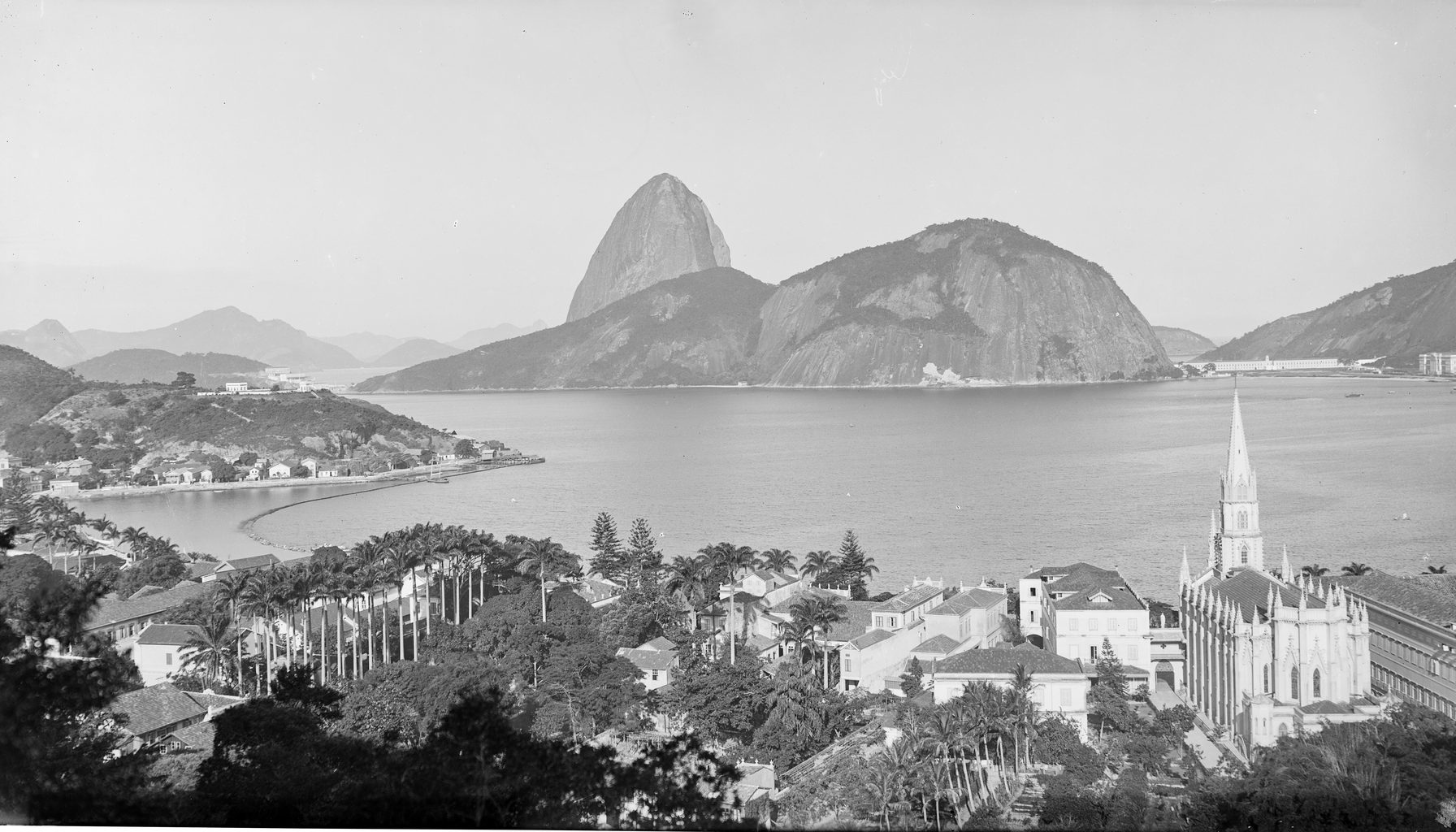
Botafogo cove in Rio de Janeiro around the turn of the twentieth century, looking across the water to the Sugarloaf. The city had already been the seat of colony, kingdom and empire; it was then the capital of the young republic, and remained so until Brasília opened in 1960. Wikimedia Commons / Public domain
Countries & Regional History | Country
Brazil
People were living at the far end of South America by about 14,500 years ago. That means they had already crossed the whole continent, coast to coast, long before anyone in Europe had heard of it. Brazil's own oldest firmly dated sites come somewhat later.
Over the centuries that followed, farmers in the south-west Amazon bred a wild shrub into manioc, the root crop that still feeds most of lowland South America. Coastal peoples built shell mounds more than thirty metres high. Villages on the lower Amazon made pottery older than any known from Mexico or the Andes, and other villages built up patches of fertile black soil that farmers still seek out today. None of it was borrowed from anywhere else.
By 1500, Tupi-speaking peoples held most of the Atlantic coast, and Je-speaking peoples held the highlands behind them. Nobody knows how many people lived in what is now Brazil before Europeans arrived. Estimates run from under a million to more than four million, by methods too different to average into one number.
On 22 April 1500, a Portuguese fleet bound for India sighted land and stopped for nine days. Pedro Álvares Cabral's ships said Mass and took on water. Two convicts were left behind to learn the language.
The fleet's clerk wrote home that there was no gold and no silver, only good land and endless water. His advice to the king was to convert the people. His second idea was a stopping post on the way to India.
Brazil the land is at least fourteen thousand years old. Brazil the country, in any sense a reader today would recognise, is about two hundred. Almost everything in between is the story of a place worked far more than it was settled.
MASTER TIMELINE
100%
Scroll or drag to explore · Use slider or +/− to zoom · Click any event
WHO, WHAT, AND WHY IT MATTERS
Brazil is the largest country in South America, and the only one where people speak Portuguese instead of Spanish. Its 2022 census counted 203,080,756 people.
For most of its five hundred years as a colony and then a country, Brazil ran as an export machine. Dyewood came first, cut and carried out for a red dye Europe wanted. Then sugar, then gold, then coffee, then Amazon rubber, then manufactured goods. Today the exports are soy, iron ore and offshore oil, sold largely to one customer: China.
The labour that built the first four of those industries was owned by somebody else. Indigenous people were enslaved first. As epidemics and resistance thinned that workforce, Brazil began importing enslaved Africans in numbers no other country in the Americas approached.
SlaveVoyages, the standard model-based estimate of the Atlantic slave trade, puts landings in Brazil at 4,864,377 people, queried on 5 August 2026. That is 45.4 per cent of everyone landed in the entire trade, against 388,744 in mainland North America.
Brazil did not become a country by revolution. A Portuguese prince declared it independent in 1822 and put his own family on the throne. The same landowners kept their land. Slavery lasted another sixty-six years after that, longer than anywhere else in the Americas.
THE MOST IMPORTANT THING
The frame before the details
Brazil was built as an export machine, worked first by enslaved Indigenous people and then by enslaved Africans in numbers no other country in the Americas approached. Every era since has been an attempt to become something else: a monarchy, a republic, an industrial power, a democracy.
Those attempts were not empty gestures. Brazil's land reform agency, INCRA, has settled 1,293,541 families on 94.8 million hectares, across 9,962 separate projects, on its own registry.
But only about a quarter of that land came from the legal tool the 1988 constitution actually created for it: expropriating unused estates. And the Gini index measuring how unequally land is held in Brazil was 0.855 in 1975 and 0.864 in 2017, essentially unchanged, on economist Rodolfo Hoffmann's reading of the government's own agricultural census.
The reform happened. The distribution did not move. Hoffmann's own conclusion is that redistributing land would not, on its own, transform Brazil's income distribution today, because agriculture supplies under 4 per cent of declared income. Brazil changed who could vote, who could own a factory and who ran the government. It has not yet changed who owns the ground.
THE DARK SIDE
Estimates of how many Indigenous people lived in what is now Brazil before 1500 range widely. Alfred Kroeber's 1939 estimate put it under a million. John Hemming's is 2,431,000.
William Denevan reached 4,834,000 for the Amazon basin inside modern Brazil, then revised his own figure down to 3,625,000. The methods differ too much to average.
Smallpox killed an estimated 30,000 people under Portuguese control in 1562, and measles killed roughly as many the next year, on Jesuit and official estimates rather than an actual count. Sugar output kept rising through the same years. Brazil's 2022 census counted 1,694,836 Indigenous people.
Resistance is also in the record. Palmares survived attack after attack over most of a century. Historian Stuart Schwartz puts its population in the 1690s at around 11,000. Not everyone living inside it was free.
Brazil's truth commission, reporting in December 2014, documented 434 people killed or disappeared under the military governments of 1964 to 1985, and named 377 state agents. It called 434 a floor, set by its own standard of evidence. The same investigation counted at least 8,350 Indigenous deaths in the period of military government, most of them among two peoples, and said that number fell far short of the real toll. No named agent has ever been convicted.
Police killed 6,602 people in Brazil in 2025, the highest number on record and 82 per cent of them Black, according to the Fórum Brasileiro de Segurança Pública. That happened in a year when Brazil's overall rate of violent death fell to its lowest since 2012.
WHY IT MATTERS TODAY
The modern echo
A commodity export boom in the 2000s helped pay the first real instalment on the 1988 constitution's promises. Bolsa Família, a cash transfer created in 2003, cost about half a per cent of GDP. A 2013 study in The Lancet found that child deaths from malnutrition were about two-thirds lower in areas where the programme reached most families. It worked partly because it moved income, not land or other assets.
The same country's numbers support a harder reading too. Economists Marcelo Medeiros, Pedro Souza and Fábio Ávila de Castro used tax returns from 2006 to 2012 and found that the richest 1 per cent of Brazilian adults took a quarter of all income. Brazil raises 13.0 per cent of GDP through taxes on goods and services, against an OECD average of 10.5 per cent, a mix Brazil's own tax authority calls more regressive than most.
Both halves of that tax system have just been rebuilt. A constitutional amendment of December 2023 replaced the old consumption taxes with a value-added tax, and a law passed in November 2025 taxed dividends for the first time since 1995. The old taxes stay in place until 2033, so nobody yet knows what the new system will actually do.
Clearing in the Amazon fell to 5,731 square kilometres in the 2025 monitoring year, the lowest recorded since 2014. But since 2023 the neighbouring Cerrado savanna has lost more vegetation every year than the Amazon has, most of it in the soybean states that now supply the export China buys. Brazilians disagree about whether the 1988 constitution's promise is being kept slowly, or whether a boom simply built a floor under the poor while leaving the ownership above it untouched. Both sides point to the same numbers.
3 SURPRISING FACTS
Fast facts worth sharing
- Brazil is named after a dye, not a person or a place. "Brasil" was European shorthand for red dyewood before any European had seen South America. A phantom "Isle of Brazil" already sat on a map, the Medici atlas of 1351, more than a century before Cabral's fleet arrived.
- From 1808 to 1821, the capital of the entire Portuguese empire stood in South America. Portugal's colonies in Africa and Asia were governed from Rio de Janeiro, not from Lisbon.
- For four months in 1994, Brazil deliberately ran two different inflation rates at once: about 3 per cent in a new accounting currency, and about 190 per cent in the money people were actually paid in.
DEEP DIVE
Unlock the full six-day course
This Snapshot moves fast across five centuries. It skips almost all of the fourteen thousand years before Cabral, and it never gets inside the documents: ship's manifests, royal decrees, court rulings, the two-sentence law that ended slavery.
**Day 1: Before Brazil** goes back to the first people on the continent. It follows manioc farmers, shell-mound builders and Amazon potters across thousands of years the popular history usually skips, and ends on a ship's manifest that lists logs, then parrots, then thirty-five people, in the same hand.
**Day 2: Sugar and the Slave Coast** follows the sugar mills that built the colony's first economy, the epidemics that emptied the Indigenous mission villages within five years, and the century-long resistance of Palmares.
**Day 3: The Gold Century** follows the gold rush that moved the colony's capital, its population and its slave trade south and inland. It also follows the crown's four attempts to redesign its own tax system, without ever touching who did the digging.
**Day 4: The Throne in the Tropics** runs from a king's flight across the Atlantic to a law two sentences long. It covers independence, Brazil's only monarchy, and eighty years of a slave society trying to postpone its own end.
**Day 5: Republic, Vargas and the Generals** covers a century in which Brazil changed what it sold and who ran the government, and rarely let most Brazilians vote on either.
**Day 6: Brazil Today** measures the country against its own 1988 constitution. It is exact about what recent Supreme Court rulings on Indigenous land, and a former president's conviction, did and did not decide.
RELATED COURSES