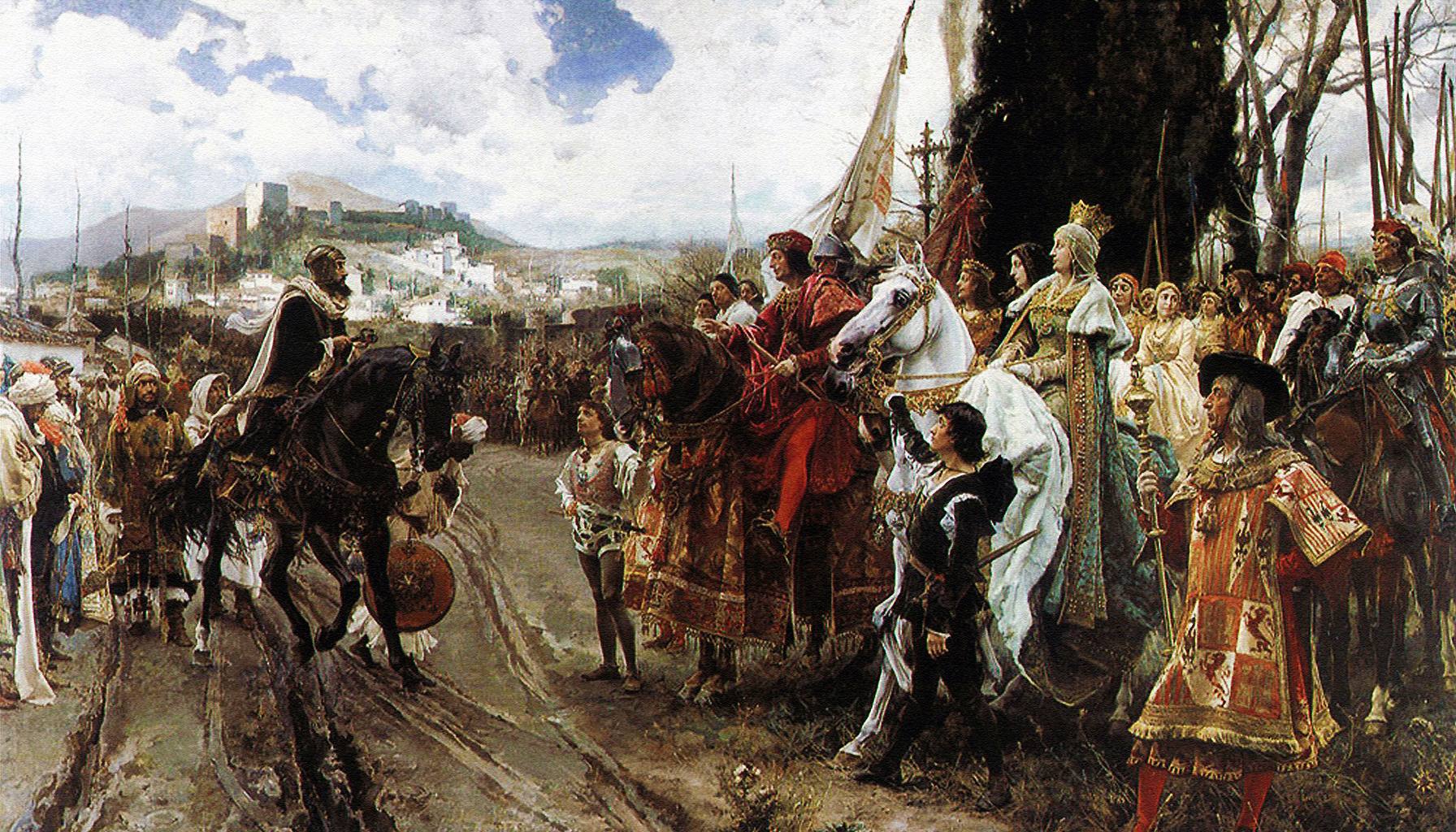
Editorial scaffold for Spain. Replace with licensed photography, maps, archival imagery, or illustration before launch.
Countries & Regional History | Country
Spain
Around 800 BCE, traders from the Phoenician city of Tyre landed on a small island off Spain's south-west coast and built a walled port. They came for the silver and tin of the interior. They called it Gadir. Today it is Cádiz, and it has been lived in, without a gap, longer than any other city in western Europe.
Spain the place is that old. Spain the country is not.
For roughly the next two and a half thousand years, this land held many peoples and many separate states. It did not hold one, until surprisingly late in its own story. Phoenicians, Greeks and Carthaginians traded up and down its coasts. Rome conquered it piece by piece and ruled it for six centuries. Visigothic kings unified it under one religion by 589 CE, then lost it to an army from North Africa in 711. For nearly eight hundred years after that, Muslim and Christian states ran side by side. They fought, traded, and often signed contracts with each other.
Textbooks usually date the birth of "Spain" to a single wedding in 1469, between the heirs to two of those Christian kingdoms. What that wedding actually joined was narrower and stranger than the textbooks suggest. The question it left open has never fully closed.
MASTER TIMELINE
100%
Scroll or drag to explore · Use slider or +/− to zoom · Click any event
WHO, WHAT, AND WHY IT MATTERS
Spain occupies most of the Iberian Peninsula, in the south-west corner of Europe. It was assembled, piece by piece, over roughly two thousand years. It was not founded in a single moment.
Phoenician and Greek traders built ports on its coasts from around 800 BCE. Rome conquered the peninsula between 218 BCE and about 19 BCE and ruled it for six centuries, leaving roads, law and the name Hispania behind. Visigothic kings then unified it under one religion by 589. An Umayyad army from North Africa ended their kingdom in 711. For the next eight centuries, Muslim and Christian states ruled side by side: the Caliphate of Córdoba at its height, then a patchwork of smaller kingdoms on both sides of the religious line.
What the two crowns of Castile and Aragon shared after their 1469 marriage was a monarch, a war, and, over time, an increasingly enforced religion. Each kingdom kept its own parliament, law, money and taxes. The only institution with real authority in both of them was a religious court, the Spanish Inquisition, created in 1478.
Almost everything that happened afterwards is one long attempt to turn that arrangement into a single country. An empire in the Americas, funded by Castile alone, briefly made Spain the richest power in Europe. A new dynasty, the Bourbons, tried to finish the job by decree in the early 1700s, abolishing the parliaments of the kingdoms that had backed the losing side in a war. Napoleon's invasion in 1808 forced Spaniards to write their own constitution for the first time. A civil war from 1936 to 1939 ended in a single-party dictatorship that ran for thirty-six years.
Since 1978, Spain has been a parliamentary democracy under a constitution that tried, once again, to hold difference and unity together in one sentence, without ever quite deciding which one wins. Two institutions carry that argument better than any battle does today. Catalonia's Generalitat government has been abolished twice and restored twice since 1359. The Basque Country's Concierto Económico is the arrangement under which it collects its own taxes and hands Madrid a negotiated sum. It was created in 1878, and it is still running.
THE MOST IMPORTANT THING
The frame before the details
Spain has repeatedly tried to solve the problem of its own difference by abolishing the institutions that carried it. The difference has outlived the institution, every time.
The guarantees given to Granada's Muslims in 1491 were gone within a decade. Forced conversions between 1499 and 1526 did not produce one uniform Spain; they produced a permanently suspect minority instead.
Between 1707 and 1716, the Crown of Aragon's parliaments were abolished by decree. By 1901, Catalonia had a Catalanist party sitting in the Spanish parliament anyway.
The Catalan government was abolished again in 1938, a year before the civil war ended. Under the dictatorship that followed, Catalan, Basque and Galician were pushed out of schools, publishing and public life for thirty-six years. Both regional nationalisms came back stronger than when they went in. In 2010, Spain's Constitutional Court struck down parts of a Catalan self-government law that two parliaments and a referendum had already approved, and support for independence rose afterwards.
How much of this is cause and how much is coincidence is genuinely argued among historians. Some point to the state's own weak nation-building; others point to the cultural revival of the 1830s, industrialisation, or the loss of the American colonies in 1898.
The same sequence has also produced something else: a prosperous, heavily decentralised democracy that has run continuously under one constitution since 1978, longer than any constitution Spain has ever had. Whether that record is unfinished centralism or successful federalism is exactly what Spanish politics still argues about.
THE DARK SIDE
Four topics here get rounded off in short accounts of Spain's history. All four turn on genuinely disputed numbers, and the dispute itself is part of the honest story.
1492. The Alhambra Decree gave Jews in Castile and Aragon four months to convert or leave. Historian Henry Kamen puts the number who left at around 40,000; Joseph Pérez puts it closer to 100,000, and older estimates run higher still. Pérez estimates that another 100,000 to 200,000 converted rather than leave, out of a Jewish population he puts at around 300,000. No count was taken at the time. What is certain is that the Jewish community, as a legal body, ceased to exist that summer.
The Inquisition. Working from surviving trial records, historians Jaime Contreras and Gustav Henningsen counted 44,674 trials between 1540 and 1700. Of those, 1,604 ended in a death sentence. That is 826 people executed in person, or about 1.8% of recorded cases. Those numbers are solid. But the conclusion sometimes drawn from them, that the Inquisition was mild, is contested. The count starts in 1540, which excludes the institution's harshest early decades. And an execution count says little about a body whose everyday tools were denunciation, confiscation of property, and laws that shut the descendants of converts out of public office for generations.
The Americas. There is no single honest number for how many Indigenous people died after 1492. Estimates for the whole hemisphere run from about 8 million, among historians who read the evidence conservatively, to as high as 112 million. A widely used middle estimate, from William Denevan, puts the pre-contact population at about 54 million and the 1650 population at under 6 million. Most historians agree that epidemic disease caused the majority of the deaths, though how much violence, forced labour and social collapse added to that toll is still debated.
The twentieth century. Estimates of the killings behind the front lines of the Civil War, and in the decades of dictatorship that followed, spread widely. That is mostly because historians count different periods and categories, not because the killings are in doubt. Gabriel Jackson put total war deaths at 380,000 in 1965, a figure that leaves out some 200,000 deaths after the fighting stopped. Ramón Salas Larrazábal gave 625,000. Enrique Moradiellos gave 651,000 to 735,000 in 2016. The most-cited figure for people who disappeared under the dictatorship is 114,266, from a 2008 court order; other counts run higher. Spain's official register lists 2,591 mass graves; a 2025 mapping project found close to 6,000.
WHY IT MATTERS TODAY
The modern echo
Article 2 of the 1978 constitution still reads the way it did on the day it passed. It rests Spain on "the indissoluble unity of the Spanish Nation". In the same breath, it guarantees self-government to the "nationalities and regions" inside it. Constitutionalists read that sentence as settled. Catalan and Basque nationalists read "nationality" as another word for nation. Nobody defined it then, and nobody has since.
Spain went on to devolve further than almost any country in Europe that still calls itself unitary. It is not, legally, a federation, because the constitution avoids the word. On spending, several of its regions have more control than parts of countries that do call themselves federal.
That devolution built the parliaments, broadcasters, school systems and police forces through which regional identity is now organised and expressed. It is, at the same time, the strongest argument centralists make and the strongest argument independence movements make, which is why the disagreement does not end.
Catalonia held an independence referendum on 1 October 2017, while the law authorising it was under suspension by Spain's Constitutional Court. Madrid took direct control of the region under Article 155 later that month. The people involved in organising that vote were later given an amnesty by Spain's parliament in 2024. It was upheld by the Constitutional Court in 2025 and cleared by the EU's top court in 2026. Opponents call it a self-amnesty, and Spain's Supreme Court still maintains an arrest warrant against the movement's exiled former leader.
Spain has changed in other ways since 1978, too. Its economy closed much of the gap with the rest of Europe after joining the European Community in 1986. It has since given part of that back, from 105% of the EU average in 2006 to 92% in 2024. Since the late 1990s it has become a country people move to rather than leave. About one in five residents was born abroad by 2026, and the country has one of the world's lowest birth rates. Whatever the constitution's unanswered question turns out to mean, the country asking it looks very different from the one that wrote it down in 1978.
3 SURPRISING FACTS
Fast facts worth sharing
- The two crowns joined by marriage in 1469 kept a customs border between them for the next 240 years. A merchant carrying goods from Zaragoza to Burgos was crossing a border, inside what is now one country.
- The Basque provinces and Navarre still collect their own taxes today and hand Madrid an agreed sum, but the arrangement is not medieval. The Basque charters were abolished in 1876, after a civil war, and replaced by the current tax deal, the Concierto Económico, in 1878. Navarre's version dates to 1841.
- Medieval Spaniards never used the word "Reconquista." Historian Martín Ríos Saloma traces the word itself to the late 1700s, and its use as a national story to the 1800s. That means the name for the period was invented long after the period was over.
DEEP DIVE
Unlock the full six-day course
This Snapshot gives you the arc. It does not give you the documents, and Spain's story turns on documents, contracts and decrees whose exact wording changes everything.
**Day 1: Before Spain** goes back to 800 BCE. It follows Phoenicians, Romans, Visigoths and the states of al-Andalus across twenty-two centuries, in which the peninsula's normal condition was several separate states at once, and never one.
**Day 2: Two Crowns** opens on the forged papal bull itself. It follows ten years of siege warfare, and the surrender terms Granada was promised and then denied. It also follows the two separate decrees it took to order every Jew in Castile and Aragon to convert or leave.
**Day 3: The Silver Century** shows why the American empire belonged in law to Castile alone. It shows what the silver mountain of Potosí actually cost the people who worked it, and what happened when a chief minister finally asked Spain's other kingdoms to help pay for it.
**Day 4: A New Dynasty** reads the Nueva Planta decrees in their own words. It explains why Navarre and the Basque provinces kept everything the Crown of Aragon lost, and follows the century in which Basque and Catalan nationalist movements were both organised.
**Day 5: The Broken Century** covers the loss of the last empire in 1898, a republic that could not say what Spain was, a three-year civil war, and thirty-six years of dictatorship. It gives the disputed casualty figures behind each of them.
**Day 6: Spain Today** sits with the seven men who drafted one unresolved sentence in 1978. It follows the argument that sentence left open, all the way to the polling numbers from June 2026.
Two institutions carry the whole argument across all six days: Catalonia's Generalitat, abolished twice and restored twice, and the Basque Country's Concierto Económico. The Basque Country has had it since 1878; Catalonia never has.
RELATED COURSES