VLADIMIR PUTIN - DAY 1 OF 6 · ~16 MIN
The World He Inherited
The queue outside the currency exchange office on Tverskaya Street in Moscow in the spring of 1992 begins before dawn. The people in it are not the poor. They are pensioners, factory workers, engineers, and schoolteachers — people who spent entire Soviet careers accumulating modest savings in state savings banks, trusting the state's implicit guarantee that their money would hold its value. Within four months of price liberalization, that trust has been destroyed. The 10,000 rubles a retired factory worker saved over thirty years of disciplined employment, enough under Soviet pricing to retire on, is now worth approximately twenty-five American dollars.

Contents — 7 sections
OPENING SCENE

The queue outside the currency exchange office on Tverskaya Street in Moscow in the spring of 1992 begins before dawn. The people in it are not the poor. They are pensioners, factory workers, engineers, and schoolteachers — people who spent entire Soviet careers accumulating modest savings in state savings banks, trusting the state's implicit guarantee that their money would hold its value. Within four months of price liberalization, that trust has been destroyed. The 10,000 rubles a retired factory worker saved over thirty years of disciplined employment, enough under Soviet pricing to retire on, is now worth approximately twenty-five American dollars.
A woman near the front of the queue holds a single sheet of paper: a privatization voucher. Every Russian citizen has been issued one, worth 10,000 rubles, redeemable for shares in newly privatized enterprises. She does not know which enterprises are worth buying into, does not have access to a financial newspaper, and does not trust any of the men who have set up folding tables on the street offering to buy vouchers for cash. She needs the cash more than the voucher. She takes the offer. The man at the folding table pockets the voucher and moves to the next person in line. By the end of the week, he will have accumulated enough vouchers to acquire a significant stake in a Soviet-era chemical plant whose true market value dwarfs the total sum he has paid. He is twenty-six years old, and he is becoming an oligarch.
This scene — ordinary people trading their stake in the Soviet economy for immediate survival — is the founding transaction of post-Soviet Russia. It explains, more than any political theory, why the decade that followed produced such rage, and why the politician who arrived in 1999 promising to reverse its logic found an audience that was not merely receptive but desperate.
DID YOU KNOW?
Between 1990 and 1994, Russia's male life expectancy fell from 63.8 years to 57.6 — a peacetime decline of six years in four years that had no modern equivalent in any industrialized country not at war. **The Soviet-era public health system, which had provided free universal care through enterprise-based clinics, collapsed simultaneously with the enterprises that funded it, leaving millions without access to the drugs and treatments that had been routine in the preceding decade.**
THE EMPIRE COLLAPSES: DECEMBER 1991

The Soviet Union did not simply lose an election or dissolve a government. It was a complete civilization in the sociological sense: a set of institutions, a system of meaning, an economy, and a social contract. The Communist Party provided jobs, housing, healthcare, education, and pensions not through the state directly but through the enterprise system — your factory or collective farm was your social safety net. When the Soviet state dissolved, all of these dissolved simultaneously and without replacement.
The speed of the collapse shocked even its architects. Mikhail Gorbachev had not intended to end the Soviet Union. He had intended to reform it through glasnost — openness — and perestroika — restructuring. What he did instead was create the conditions under which the system's internal contradictions became visible and then fatal. The Baltic states declared independence in 1990. Georgia, Armenia, and Azerbaijan followed. Ukraine, the second-largest Soviet republic with 52 million people, declared independence in August 1991 after a failed hardline coup. When Ukraine voted for independence by 90 percent on December 1, 1991, the Soviet Union's largest Slavic republic had gone. There was nothing left to hold together.
On December 8, 1991, the leaders of Russia, Ukraine, and Belarus met at a hunting lodge in the Belavezha Forest and signed an agreement dissolving the Soviet Union and replacing it with a loose Commonwealth of Independent States. They did not consult Gorbachev before signing. He learned of the agreement from a phone call. Seventeen days later, he resigned. The largest country by land mass in human history ended in a forest lodge meeting attended by three men, none of whom had been elected with a mandate to dissolve the state they governed.
The fifteen successor republics that emerged from the wreckage inherited varying portions of Soviet infrastructure, military capacity, and nuclear weapons. Russia inherited the permanent seat on the United Nations Security Council, the strategic nuclear arsenal, the officer corps of the Soviet military, and the bulk of the KGB's institutional structure. It also inherited a debt of approximately $70 billion, an economy organized around central planning that had no market mechanisms to replace it, and a bureaucracy whose entire expertise was in administering a system that no longer existed.
SHOCK THERAPY AND THE PRICE LIBERALIZATION OF 1992

The economic transition that followed the Soviet collapse is known in academic literature as "shock therapy" — a term coined by economists advising post-communist governments that the fastest route to a functioning market was the most rapid possible liberalization. Remove price controls, cut subsidies, sell state assets, and allow markets to self-organize. The theory was that short-term pain would produce long-term efficiency gains. In Russia, applied to an economy with no functioning banking system, no securities markets, no commercial law, and no culture of private property, the theory produced something closer to an economic war on the population.
Price liberalization on January 2, 1992, the first act of the new Russian government under acting Prime Minister Yegor Gaidar, produced inflation of 2,500 percent within twelve months. A kilogram of bread that cost 20 kopeks in December 1991 cost 8 rubles by December 1992. Heating, transport, and rent followed as subsidies were removed. The cumulative savings of the Soviet period — the 372 billion rubles held in state savings banks — were rendered nearly worthless in months. No compensation was offered. No alternative financial instrument was provided. The savings simply dissolved.
Industrial production fell by approximately 40 percent over the 1990s. Factories that had produced military equipment, machine tools, or agricultural machinery under Soviet allocation had no customers at market prices, could not afford imported inputs, and had no capital to retool for consumer goods. Unemployment, which had effectively not existed under Soviet planning, reached official rates of 12 to 14 percent and considerably more by broader measures. The social infrastructure of the Soviet enterprise system — factory canteens, worker housing, vacation facilities, on-site clinics — disappeared alongside the enterprises that had funded it.
The human cost accumulated in statistics that, read together, describe a demographic catastrophe. Male life expectancy fell from 63.8 years in 1990 to 57.6 years in 1994 — a peacetime decline unmatched by any industrialized country in the twentieth century not at war. The primary drivers were cardiovascular disease, stress-related illness, suicide, and the collapse of the public health system. The homicide rate tripled between 1990 and 1994. The suicide rate reached 41 per 100,000 in 1994, the highest recorded in Russian history. Alcoholism intensified sharply. Hospitals ran out of basic drugs. Schools stopped receiving textbooks. The term "demographic shock" entered Russian public health literature as a clinical category describing what was happening to the Russian population in real time.
THE OLIGARCHIC REVOLUTION: WHO STOLE RUSSIA
The privatization program designed to transfer Soviet state assets to Russian citizens was called voucher privatization. Every Russian citizen received a voucher worth 10,000 rubles, redeemable for shares in privatizing enterprises. The theory was democratic and genuinely well-intentioned among some of its architects: spread ownership broadly, create a shareholder class, anchor market capitalism in popular participation.
In practice, the program created the conditions for one of the largest transfers of wealth in modern history — from the general population to a small group of well-positioned individuals. Desperate people sold vouchers for cash, food, and vodka at fractions of their nominal value. A small number of individuals with access to credit, information about enterprise valuations, and relationships with the bureaucrats overseeing privatization bought vouchers cheaply, aggregated them, and used them to acquire major industrial assets. The loans-for-shares auctions of 1995 and 1996 completed the process, transferring Russia's oil, metals, and media industries to seven or eight men at prices the government's own internal documents showed were deliberately set below assessed value.
Vladimir Potanin acquired Norilsk Nickel — the world's largest nickel producer — for $170 million. Mikhail Khodorkovsky acquired Yukos, which became Russia's largest oil company, for $159 million. Roman Abramovich acquired the Sibneft oil company for approximately $100 million in 1995; it was sold to Gazprom in 2005 for $13.1 billion. These were not market transactions in any meaningful sense. They were political transactions in which proximity to the state was converted into industrial ownership at a speed and scale that had no precedent in capitalist history.
The men who made these acquisitions became known as oligarchs. They were not simply wealthy; they were wealthy in a way inseparable from political access. Their fortunes required continued state protection to survive. Boris Berezovsky and Vladimir Gusinsky, who controlled major television networks, became kingmakers in the 1996 presidential election, running effectively non-stop favorable coverage of Yeltsin — whose approval rating had collapsed to single digits — while suppressing coverage of his Communist opponent Gennady Zyuganov. Yeltsin won. The oligarchs kept their assets. The arrangement, which political scientist Karen Dawisha later described as a kleptocracy built by design rather than by accident, defined the terrain that Putin would inherit and eventually restructure under his own control.
"The collapse of the Soviet Union was the greatest geopolitical catastrophe of the century." — Vladimir Putin, State of the Nation address to the Federal Assembly, April 25, 2005
THE FIRST CHECHEN WAR: HUMILIATION IN THE MOUNTAINS
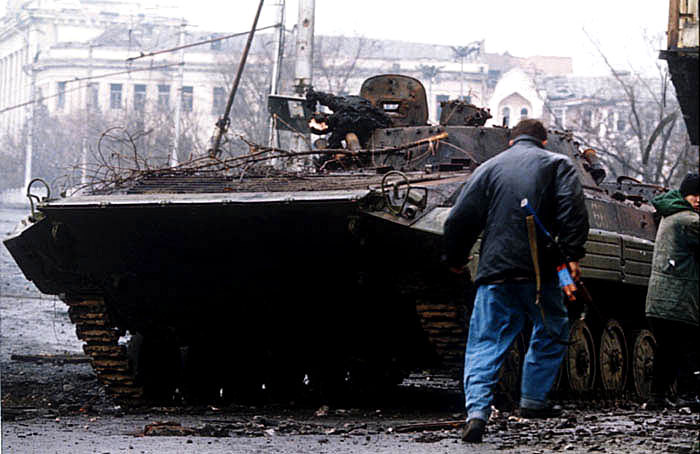
No single event of the 1990s damaged the Russian state's legitimacy more severely than the First Chechen War of 1994 to 1996. Chechnya, a predominantly Muslim republic of approximately one million people in the North Caucasus, had declared independence in 1991 under the nationalist leader Dzhokhar Dudayev. In December 1994, Boris Yeltsin ordered a military intervention to restore federal authority, expecting a quick operation that would demonstrate state competence and resolve.
What followed was a catastrophe of planning, command, and political judgment. The Russian army — underfunded, demoralized, undertrained, and poorly led since the Soviet collapse — attempted to storm the Chechen capital, Grozny, with armored columns on January 1, 1995, New Year's Day, when many officers were drunk. Chechen defenders, using the urban terrain they had prepared for months, destroyed the columns with rocket-propelled grenades fired from building windows and prepared positions. Estimates of Russian casualties in the first days range from several hundred to over a thousand dead. Entire battalions were annihilated in streets they did not know how to navigate.
The battle for Grozny dragged on for months. The war lasted nearly two years and ended in a ceasefire in which Russia effectively accepted Chechen de facto independence. The human cost was approximately 50,000 to 80,000 dead, the majority civilian. Russian military performance had been documented by journalists — most prominently Anna Politkovskaya — as incompetent, corrupt, and brutal. Mothers of dead soldiers organized protest movements. Public support for the war collapsed to below 30 percent. General Alexander Lebed, who negotiated the final ceasefire, described the Russian military as a demoralized force that could not be sent anywhere without humiliating the country.
The August 1996 Khasavyurt Accord that Lebed negotiated amounted to de facto recognition of Chechen sovereignty: Russian forces withdrew, Chechen administration was restored, and a formal decision on Chechnya's political status was deferred for five years. In that five-year interval, Chechen governance collapsed. Aslan Maskhadov, the elected president, controlled little beyond the nominal apparatus of government. Kidnapping networks proliferated; foreign jihadist fighters established training camps in the mountains; criminal networks from the war years entrenched themselves in what had become effectively a failed state within Russian borders. When Vladimir Putin launched the Second Chechen War three years later, the conditions of the interim period gave his campaign a justification that Yeltsin's 1994 invasion never possessed — genuine security disorder in the republic, genuine terrorist attacks inside Russia, and a Russian public that had spent three years watching news coverage of kidnappings and chaos from Chechnya. The first war created the conditions for the second; the second made Putin's career.
For the Russian political class, the lesson was near-universal: a state that could not suppress a separatist movement in its own territory with a population of one million had a legitimacy crisis that went beyond personnel or policy. The political demand for someone who could restore the appearance of state competence was real and widespread by the time Yeltsin's health deteriorated to the point where succession could no longer be deferred.
YELTSIN'S RUSSIA: DEMOCRACY AS SPECTACLE
Boris Yeltsin had come to power as the anti-communist reformer who stood on a tank in August 1991 and faced down the hardline coup against Gorbachev. That image of democratic courage was the last clear moment of political legitimacy in his tenure. By 1993 he was shelling his own parliament with tanks after a constitutional standoff in which both sides could claim legal justification. By 1995 he was visibly impaired by alcohol at state events. The incident in which he was unable to disembark from his aircraft in Shannon Airport for a meeting with the Irish Prime Minister became emblematic of international perceptions of his condition.
The constitution Yeltsin imposed after dissolving the parliament by force in 1993 created an extremely powerful executive with limited effective checks from other institutions. It was designed for Yeltsin's own political needs. What he did not calculate was that this constitutional architecture — enormous presidential power, weak parliamentary oversight, subordinated courts — was perfectly suited to a different and more capable executive who came after him. The tools he built for his own survival would be inherited by someone who knew how to use them far more effectively.
The constitutional crisis of October 1993 was the most instructive episode. The standoff between Yeltsin and the parliament — which had its own competing constitutional claim to authority under the 1978 Soviet-era constitution still nominally in force — ended when Yeltsin ordered tanks to fire on the White House, the parliament building, killing an estimated 100 to 187 people. He then dissolved the parliament by decree, arrested opposition leaders, and held a referendum on a new constitution that concentrated power in the executive to a degree unusual even for post-Soviet states. The referendum's legitimacy was disputed, with independent monitors questioning whether the required quorum of voter participation had been reached. Yeltsin declared victory and the new constitution came into force. The sequence established something that would echo throughout the Putin years: that constitutional authority in Russia was not a constraint on executive power but a legitimating instrument for it — something to be cited when useful and bypassed when inconvenient. Yeltsin did this in the direction of reform and survival; Putin would inherit the template and apply it with considerably more sophistication.
Russia under Yeltsin had democratic elections, a nominally free press, and a functioning parliament. But elections were influenced by media oligarchs with political interests, the press was owned by those same oligarchs, and the parliament was routinely bypassed by presidential decree. The state defaulted on its domestic debt in August 1998, wiping out the middle-class savings accounts that had survived the initial reform period. By 1999, Yeltsin's approval rating stood at approximately 2 percent — the lowest recorded approval rating for any leader of a major country in modern polling history.
What the Yeltsin period created, structurally, was an electorate that had experienced democracy primarily as chaos. Economic collapse. Political instability. Military humiliation. A ruling class visibly enriching itself while ordinary people lost everything. Surveys from the late 1990s showed that majorities of Russians rated order above freedom and strong leadership above institutional pluralism in their preferences for the political system. This was the audience Putin inherited in 1999. It was the audience he had been, in a sense, waiting for his entire career.
THE DEMAND FOR ORDER

By the summer of 1999, Russia had burned through four prime ministers in seventeen months. The economy had contracted by roughly 40 percent over the decade. The ruble had collapsed in 1998. Chechnya remained effectively independent and a source of ongoing armed incursions into neighboring Russian republics. The oligarchs who had funded Yeltsin's survival were now competing openly for influence over his succession. Criminal organizations, many of them run by former KGB and military officers using their professional networks in the new economy, controlled significant portions of major Russian cities.
Into this environment, Yeltsin introduced an unknown bureaucrat named Vladimir Putin as prime minister on August 9, 1999. Putin had been director of the FSB — the domestic intelligence successor to the KGB — for the previous year. He had no public profile. He had made no speeches. He had no party, no political base, and no media visibility. He was, in the vocabulary of the moment, a nobody — which is exactly why everyone who mattered thought he could be controlled.
Within weeks of his appointment, apartment buildings in Moscow, Buynaksk, and Volgodonsk were destroyed by explosions that killed nearly 300 people. The FSB attributed the bombings to Chechen terrorists. Putin launched a second military campaign in Chechnya — this time with sustained artillery and air preparation before ground advance, minimizing Russian casualties while achieving territorial control. By November 1999, his approval rating had reached 45 percent. By December, it exceeded 70. On December 31, Yeltsin resigned and named him acting president. The nobody from the FSB would face a presidential election in March 2000 as the frontrunner.
The conditions that made Putin possible were not accidental. They were the product of specific policy choices, institutional failures, and personal corruption accumulated across a decade. The Russian public had tried reformers, oligarchs, generals, and democrats. What they had not tried was someone who presented himself as the state itself — disciplined, decisive, and specifically designed to reverse the humiliations of the preceding decade. Whether Putin actually delivered on that presentation, and at what cost, is the subject of the next five days.
Why it matters today
The conditions of the 1990s remain the foundation of Putin's political legitimacy in 2025. His entire narrative rests on the comparison between the chaos of the Yeltsin decade and the stability — however coercive — that he delivered. That narrative is increasingly strained as the Ukraine war produces economic pressure and casualty figures that recall the Chechen disaster at orders of magnitude larger scale. But it has been remarkably durable across more than two decades, because the memory of the 1990s in Russia is not a political abstraction. It is a lived experience of financial destruction, social collapse, and national humiliation that tens of millions of adults still carry personally.
Beyond Russia, the 1990s lesson has been absorbed by authoritarian governments worldwide. The IMF and World Bank's post-Cold War structural adjustment programs, applied in dozens of countries from Eastern Europe to sub-Saharan Africa to Latin America, created conditions in many of them that resembled Russia's 1990s in miniature. The political responses — the rejection of liberal institutional prescriptions, the turn toward strongman politics, the demand for order over pluralism — are visible across the developing world from Hungary to Venezuela to the Philippines. **Russia was the most consequential proof of concept that economic crisis, combined with institutional vacuum, is not the precondition for democracy but the precondition for its opposite.**
The specific mechanism Russia demonstrated — an institutional vacuum filled by a security-services figure who consolidates executive control rapidly — has recurred in diverse forms across the post-Cold War period. In Venezuela, Hugo Chávez emerged from a failed 1992 coup attempt and won the presidency six years later on a platform of reversing an economic collapse with structural similarities to Russia's 1990s. In Egypt, a military officer displaced an elected government in 2013 in conditions of economic stress and institutional uncertainty. In each case, the consolidation was faster than the democratic consensus expected, because the institutions being dismantled had not yet developed the roots that make their removal politically costly. **The practical lesson for democratic institution-building is direct and uncomfortable: institutions under economic stress require material support from established democracies in their formation years, not simply procedural advice, because the window in which they can be captured is brief and the capture, once complete, is difficult to reverse without an external shock.**
The political consequences of the 1990s shock also did not dissipate after Russian economic stabilization in the early 2000s. Putin's core legitimacy narrative — "I ended the chaos" — remained effective more than twenty years after the chaos it referenced ended, because the memory of that period persists in tens of millions of adult Russians as lived experience rather than historical abstraction. The man who lost his savings in 1992, the woman who sold her privatization voucher for cash to feed her children, the soldier who survived Grozny — they had direct personal stakes in the narrative that the 1990s were an aberration rather than a preview. **In this sense, the political debt of the shock therapy decade is still being paid — not by the reformers who designed it or the oligarchs who profited from it, but by Ukraine and by the Russian families who have lost people in a war that the political structures of the 1990s made possible.** The full accounting remains incomplete.
3 key takeaways
- The Soviet collapse was total, not partial: It simultaneously destroyed an economy, a social contract, and a system of meaning. The resulting collective trauma — financial ruin, demographic shock, military humiliation — shaped Russian politics for decades, and Putin converted it into a legitimacy narrative that remained effective for more than twenty years.
- The oligarchic privatization created the architecture Putin inherited: The transfer of state assets to politically connected individuals through rigged voucher schemes and loans-for-shares auctions produced not capitalism but a political economy in which private wealth required state protection and state protection required political loyalty — a system Putin would later reorganize under his own control.
- The Chechen disaster created the demand Putin answered: The First Chechen War's humiliating outcome — a Russian military unable to defeat a separatist movement of one million people — produced a political demand for restored state competence that was shared across the Russian political spectrum, and that Putin's second Chechen campaign explicitly and immediately answered.
KNOWLEDGE CHECK
You finished Day 1 — test yourself
SESSION QUIZ
Check what stuck
1. What happened to the ruble savings of ordinary Soviet workers in the first year of price liberalization in 1992?
2. Why do historians treat the loans-for-shares auctions of 1995–1996 as the foundation of the system Putin later inherited, rather than simply a story of a few men getting rich?
3. What was the primary political consequence of the First Chechen War of 1994–1996?
4. The Khasavyurt Accord of 1996 ended the First Chechen War. What conditions did the five-year interim period it established produce — and how did those conditions shape the Second Chechen War three years later?
5. After shelling his own parliament in October 1993 and defeating the opposition by force, Yeltsin imposed a new Russian constitution by referendum. What was the most significant long-term consequence of that constitution's design?