BRAZIL - DAY 3 OF 6 · ~33 MIN
The Gold Century
Vila Rica, July 1752. Clerks in a low building on the main street close the year's accounts.
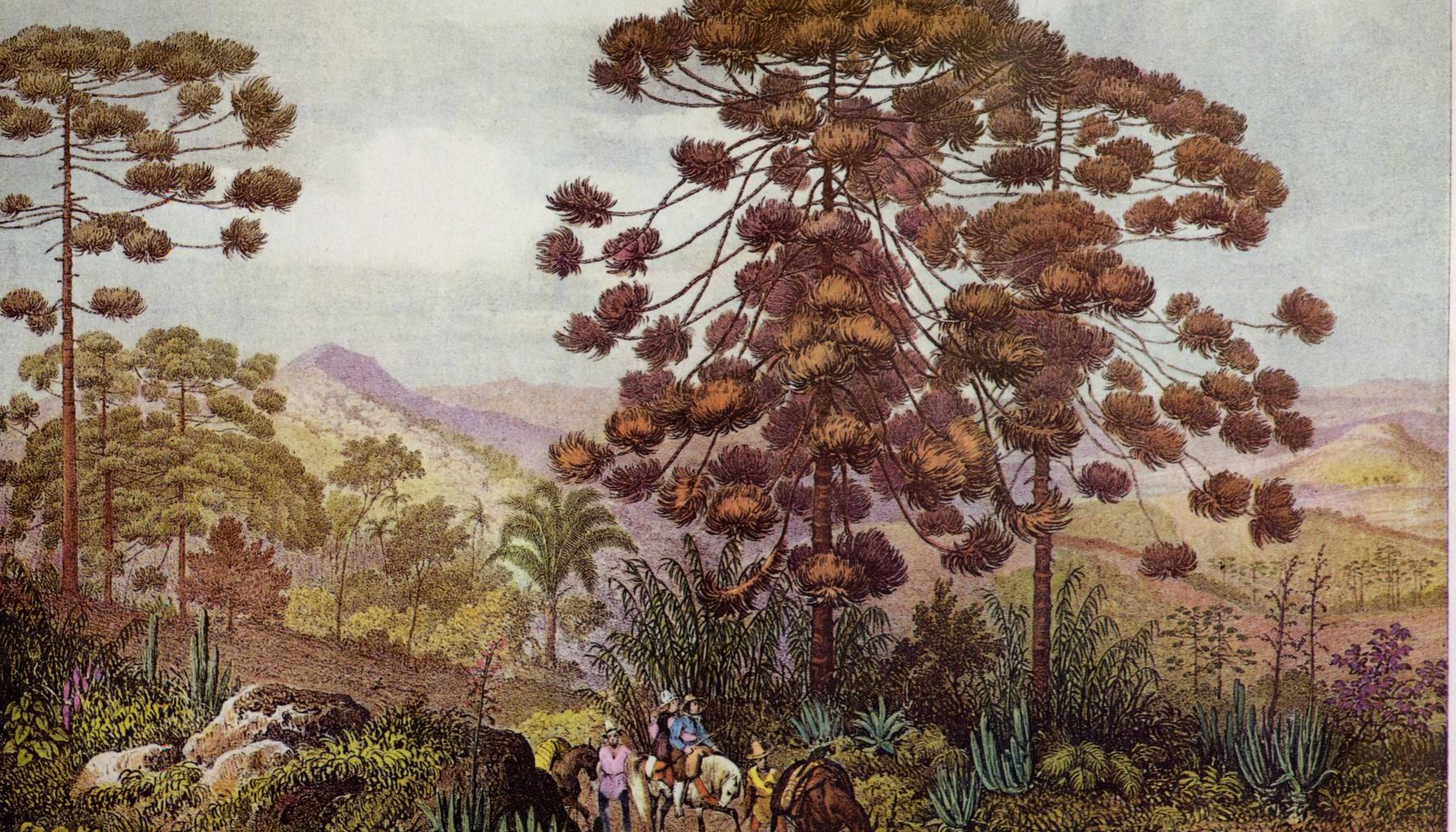
The Serra do Ouro Branco in Minas Gerais, drawn from life by Johann Moritz Rugendas and published as a hand-coloured plate in Paris between 1827 and 1835. Araucaria pines stand on the high ground above a valley, and on the track below a party of travellers moves with pack animals. Routes like this one carried the gold century. The mining district sat hundreds of kilometres of broken country from any port, so everything that went in or came out went on the backs of mules. The road built for that traffic, the Caminho Novo, opened in stages from 1698 and pointed the metal at Rio de Janeiro. In 1763 the government followed the same road south. Johann Moritz Rugendas / Wikimedia Commons / Public domain
Contents — 9 sections
- OPENING SCENE
- THE LAST OF PALMARES, AND THE FIRST OF THE GOLD
- A WAR OVER THE DIGGINGS, AND A TOWN ON THE BLACK ORE
- FIVE WAYS TO TAKE A FIFTH
- A FENCE AROUND THE DIAMONDS, AND A TAX THAT COUNTS PEOPLE
- A NEW BORDER, FREEDOM SOLD IN INSTALMENTS, AND A WAR
- POMBAL REBUILDS THE COLONY
- THE GOLD RUNS DOWN, AND THE ARREARS BUILD
- TWO CONSPIRACIES, AND A FLEET LEAVING LISBON
OPENING SCENE

Vila Rica, July 1752. Clerks in a low building on the main street close the year's accounts.
The building is a royal smelting house. It opened for business the previous August, and from that month every ounce of gold in the captaincy was supposed to pass through it.
Gold arrives there as dust and grains. It is melted down and leaves as a stamped bar, with a fifth of it kept for the king. A sealed bar is gold the crown has been paid on. Gold dust in a pouch, which is how people in Minas actually carried money, is legally suspect.
Over the twelve months to July 1752 the building took in 55 arrobas, 13 arráteis, 7 onças, 1 oitava and 39 grãos of gold on the king's account.
The units are worth knowing. An arroba of gold runs to about 14.69 kilograms. An oitava is 3.586 grams, and a grão is a grain, the smallest weight the system bothers to name.

So the royal revenue for the year was counted down to a single grain. It came to a little over 800 kilograms.
The quota those officials had been told to deliver was 100 arrobas, which is about 1,469 kilograms. They had delivered a little over half of it.
The system this one replaced had brought in 114 arrobas and 907 oitavas in its final year, comfortably above the quota. It had done that by counting people rather than gold, and it had just been abolished at the request of the men who paid most of it.
The shortfall did not stay a shortfall. Arrears built from here into a threatened emergency levy, and the levy became a conspiracy in 1789.
Today's Core Question: The crown rebuilt its tax machine four times in thirty-eight years. Why did it never rebuild the labour system underneath it?
LOCKED AFTER THE PREVIEW
What's in the rest of Day 3
- THE LAST OF PALMARES, AND THE FIRST OF THE GOLD
- A WAR OVER THE DIGGINGS, AND A TOWN ON THE BLACK ORE
- FIVE WAYS TO TAKE A FIFTH
- A FENCE AROUND THE DIAMONDS, AND A TAX THAT COUNTS PEOPLE
- A NEW BORDER, FREEDOM SOLD IN INSTALMENTS, AND A WAR
- POMBAL REBUILDS THE COLONY
- THE GOLD RUNS DOWN, AND THE ARREARS BUILD
- TWO CONSPIRACIES, AND A FLEET LEAVING LISBON