BRAZIL - DAY 5 OF 6 · ~44 MIN
Republic, Vargas and the Generals
Rio de Janeiro, the morning of 15 November 1889.
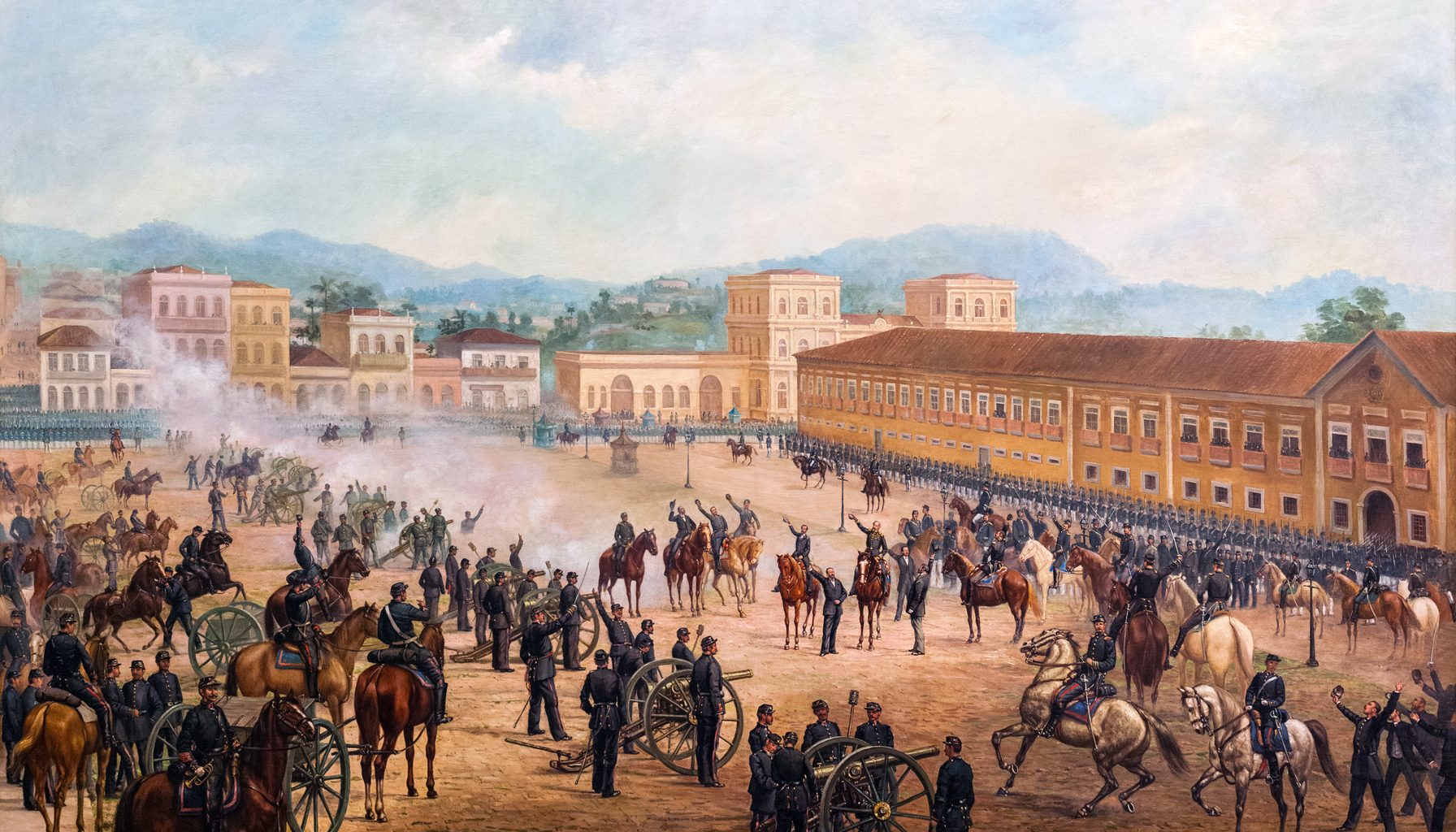
Benedito Calixto's painting of the morning of 15 November 1889, made four years after the event. Troops, field guns and horses stand drawn up in the square in front of the long yellow barracks that housed the army command in Rio de Janeiro, with smoke drifting across the ranks. Almost every figure in the frame is a soldier. That is what the picture teaches. The emperor's government was removed by the army, in a square most of the city had no reason to be standing in, and the whole thing was finished before lunch. Benedito Calixto / Wikimedia Commons / Public domain
Contents — 10 sections
- OPENING SCENE
- A REPUBLIC WITH A GATE AT THE DOOR
- THE COUNTRY OUTSIDE THE COFFEE BELT
- THE ARRANGEMENT STARTS TO CRACK
- A REVOLUTION THAT WAS NOT ONE
- CONGRESS IS CLOSED
- THE DECADE THAT MADE THE LETTER
- FIFTY YEARS IN FIVE
- TWELVE DAYS IN 1964, AND THE ACT THAT SUSPENDED THE LAW
- THE BILL, AND THE LONG EXIT
OPENING SCENE

Rio de Janeiro, the morning of 15 November 1889.
Troops under Marshal Deodoro da Fonseca ride into the square at Campo de Santana and occupy the war ministry. The cabinet resigns. A provisional government is proclaimed before most of the city knows anything has happened.
A journalist called Aristides Lobo watched it and wrote his dispatch the same day. A São Paulo paper printed it three days later.
The people, he wrote, watched the whole thing "bestializado, atônito, surpreso", stupefied and astonished and surprised, without knowing what it meant. Many of them, he said, believed they were watching a parade. Recent historians argue that the line understates how widely republican ideas had already circulated.
The imperial family was told to leave. Princess Isabel had signed the law ending slavery eighteen months earlier. She spoke the next day. "If abolition is the cause for this, I don't regret it; I consider it worth losing the throne for."

Her father was more tired than defiant. "If it is so," Pedro II said, "it will be my retirement. I have worked too hard and I am tired."
A flag went up over the new government that afternoon. It had stripes and a corner block of stars, and it looked very like the flag of the United States. It lasted four days.
What replaced it stayed. So did the men who owned the land, the crop the economy ran on, and the rule that kept most Brazilians out of the vote.
Over the ninety-six years that follow, Brazil changed what it sold twice. It went from coffee to steel and cars, and it built a capital in the middle of the country to prove it.
Today's Core Question: The country changed what it sold, twice. Why did that never change who owned it?
LOCKED AFTER THE PREVIEW
What's in the rest of Day 5
- A REPUBLIC WITH A GATE AT THE DOOR
- THE COUNTRY OUTSIDE THE COFFEE BELT
- THE ARRANGEMENT STARTS TO CRACK
- A REVOLUTION THAT WAS NOT ONE
- CONGRESS IS CLOSED
- THE DECADE THAT MADE THE LETTER
- FIFTY YEARS IN FIVE
- TWELVE DAYS IN 1964, AND THE ACT THAT SUSPENDED THE LAW
- THE BILL, AND THE LONG EXIT