WORLD WAR TWO - DAY 1 OF 6 · ~19 MIN
The World That Made War Inevitable
The Hall of Mirrors is 240 feet long. Seventeen arched windows face the gardens; 357 mirrors reflect them from the opposite wall. On most days in the summer of 1919, it is full of diplomats, journalists, and Allied military officers in dress uniform. The German delegates are not part of those conversations. They are brought in after the text has been finalized, told to sign, and escorted out. No negotiation. No amendment. The victors have decided.
Contents — 7 sections
OPENING SCENE

The Hall of Mirrors is 240 feet long. Seventeen arched windows face the gardens; 357 mirrors reflect them from the opposite wall. On most days in the summer of 1919, it is full of diplomats, journalists, and Allied military officers in dress uniform. The German delegates are not part of those conversations. They are brought in after the text has been finalized, told to sign, and escorted out. No negotiation. No amendment. The victors have decided.
The lead German delegate, Foreign Minister Hermann Müller, understands what he is signing. The reparations clause alone — the equivalent of $33 billion USD — is larger than the annual output of the entire German economy. The war guilt clause, Article 231, will become the most politically toxic sentence in German history: "Germany accepts the responsibility of Germany and her allies for causing all the loss and damage to which the Allied and Associated Governments and their nationals have been subjected as a consequence of the war imposed upon them by the aggression of Germany and her allies."

German newspapers print the text in black borders, as if mourning a death. The war had killed 2 million German soldiers; the peace would feel, to many Germans, like a second humiliation inflicted on top of the first. That feeling was the raw material from which the next war would be built.
DID YOU KNOW?
The Treaty of Versailles was signed on June 28, 1919 — exactly five years after the assassination of Archduke Franz Ferdinand, the event that triggered World War One. The date was deliberately chosen by the Allied powers to underscore the connection between German aggression and the peace terms. The German delegates were not told the date carried this significance until they arrived.
THE HALL OF MIRRORS: VERSAILLES AND ITS TERMS

The Paris Peace Conference opened on January 18, 1919, and the resulting treaty was signed on June 28 — five years to the day after the assassination of Archduke Franz Ferdinand, the event most historians mark as World War One's trigger. The date was not accidental. The Allies wanted Germany to understand the connection.
The "Big Four" who dominated the negotiations were US President Woodrow Wilson, British Prime Minister David Lloyd George, French Prime Minister Georges Clemenceau, and Italian Prime Minister Vittorio Orlando. They brought fundamentally incompatible goals to the table.
Wilson wanted a "peace without victory" based on his Fourteen Points — self-determination for national groups, freedom of the seas, open diplomacy, and a League of Nations to arbitrate future disputes. Lloyd George wanted Germany punished enough to satisfy British public opinion but not so damaged that Germany destabilized Europe or stopped being a trading partner. Clemenceau wanted Germany crushed. France had suffered approximately 1.4 million military dead and 400,000 civilians killed. French industrial regions had been occupied for four years. The French public expected Germany to pay, and Clemenceau was not going to disappoint them. Orlando was primarily concerned with Italy receiving the territories promised in the secret 1915 Treaty of London, which drew Italy into the war. When it became clear Italy would not get all it wanted, Orlando walked out of the conference, weakening his country's position further.
The reparations sum — 132 billion gold marks — was set by the Allied Reparations Commission in May 1921, after the treaty itself had been signed with the amount deliberately left blank. Historians have since debated vigorously whether this sum was actually payable or primarily punitive. Economist John Maynard Keynes, in "The Economic Consequences of the Peace" (1919), argued it was catastrophically excessive and would destabilize Europe. Historian Sally Marks, writing in 1978, argued the actual operative reparations demand (the "A" and "B" bonds) was closer to 50 billion marks — still a large sum but not the catastrophic number usually cited. Germany paid approximately 22 billion marks before the payments system collapsed in the Depression.

The territorial losses were concrete and immediate: Alsace-Lorraine returned to France; the Polish Corridor (separating East Prussia from the rest of Germany) created to give Poland access to the sea; the Saar coalfields placed under League of Nations administration for 15 years; the Rhineland demilitarized and temporarily occupied by Allied forces. Germany also lost all its overseas colonies — distributed to Britain, France, Japan, and others as League of Nations "mandates."
The army cap — 100,000 men, no conscription, no tanks, no air force, no submarines — was particularly galling to the German military establishment, which had fielded 13.5 million men during the war. Germany was left large enough to know it had been a great power and too restricted to exercise that power.
What the Versailles settlement did not do was what Clemenceau had originally wanted: it did not occupy Germany permanently, did not partition it, and did not destroy its industrial base. Germany emerged humiliated but intact. This combination — a powerful country that felt treated unjustly — proved more dangerous than either a crushed Germany or a fairly treated one would have been.
THE WEIMAR REPUBLIC: DEMOCRACY IN AN AGE OF CATASTROPHE

The German republic that signed the treaty is known as the Weimar Republic after the city where its constitution was drafted. It was Germany's first genuine democracy, and it governed from 1919 to 1933.
The republic's founders faced an impossible situation from day one. They inherited a lost war, a shattered economy, a society in shock, and a political culture with no democratic tradition. The Social Democrats who led the new government had to sign the armistice (November 1918) and the treaty (June 1919), earning the name "November criminals" from the right — the men who, in the nationalist myth, had stabbed the undefeated German army in the back. This "stab in the back" ("Dolchstoss") legend was false — the German army had been decisively defeated militarily — but it was politically powerful. It became one of the foundational myths of the Nazi movement.
The republic's first years were violent. In January 1919, a communist uprising (the Spartacist revolt, led by Rosa Luxemburg and Karl Liebknecht) attempted to seize Berlin. The government suppressed it using right-wing irregular troops called Freikorps. Luxemburg and Liebknecht were murdered by Freikorps officers. In 1920, right-wing nationalists attempted a coup (the Kapp Putsch), which failed when German workers went on general strike. In 1921–1923, political assassinations of prominent democratic politicians — including Foreign Minister Walther Rathenau — were common. The political atmosphere was saturated with violence.

The hyperinflation of 1923 was the crisis that permanently shaped German political memory. Its cause was specific: France and Belgium occupied the Ruhr industrial valley in January 1923 to extract reparations in kind after Germany defaulted on coal deliveries. The German government, unable to resist militarily, called for passive resistance — workers should strike — and funded the resistance by printing money. The result was monetary collapse. By November 1923, the exchange rate reached 4.2 trillion marks to the dollar. A loaf of bread cost 200 billion marks in November that had cost less than a mark in January 1922. Workers were paid twice daily so their wages would not lose value between morning and afternoon. People burned banknotes for heat because they were cheaper than firewood. The savings of the German middle class — built over decades — were destroyed in months.
The Rentenmark reform stabilized the currency by November 1923, and the Dawes Plan (1924) restructured reparations payments with American bank loans. The mid-1920s saw genuine economic recovery. But the trauma of 1923 had planted something permanent: a terror of inflation and a distrust of democratic institutions that had presided over it. When the Great Depression arrived in 1929, the psychological ground had already been prepared.
THE GREAT DEPRESSION AND THE NAZI RISE

The Wall Street Crash of October 1929 was the starting gun for the global economic depression that would make the political climate of the early 1930s so dangerous. For Germany specifically, the mechanism was direct: American banks, having made substantial loans to Germany under the Dawes Plan, called those loans in when they needed liquidity. German banks, suddenly deprived of their American credit line, stopped lending. German businesses, suddenly deprived of credit, cut production and dismissed workers.
German unemployment, which had stood at approximately 1.3 million in 1929, rose to 3.07 million by the end of 1930, 4.88 million by the end of 1931, and over 6 million by early 1932 — roughly 30 percent of the workforce, with some estimates reaching 35 percent when partial employment is included. For comparison: the US unemployment rate peaked at approximately 25 percent in 1933. No major European democracy was under more acute economic stress than Germany.
The political consequences tracked the economic deterioration precisely. In the 1928 Reichstag election, the NSDAP (Nazi Party) won 2.6 percent of the vote — a fringe movement. In September 1930, as unemployment surged past 3 million, the Nazis won 18.3 percent, becoming the second-largest party in parliament. In July 1932, with unemployment above 6 million, they won 37.4 percent — the largest any single party would win in a free German election — and became the dominant force in parliament.
Who voted Nazi? The research of historians including William Sheridan Allen (studying a single German town in meticulous detail in "The Nazi Seizure of Power," 1965) and the subsequent quantitative work of scholars like Jürgen Falter show that the Nazi vote was extraordinarily broad. The party drew disproportionately from the Protestant rural areas, small-town artisans, shopkeepers, and civil servants — the "old middle class" being squeezed between big business and organized labor. It drew less well in Catholic Germany (where the Centre Party remained strong) and among the industrial working class (where the Social Democrats and Communists competed). But the 37.4 percent of July 1932 included voters from every economic and social class.
What the Nazi Party offered that no other German party could match was a combination of nationalist passion, a clear enemy to blame, and the organizational capacity to turn out massive, disciplined street demonstrations. But ideology alone does not explain the breadth of support. Once in power, the Nazi government delivered visible economic results that strengthened its popular base. Unemployment fell from 6 million in early 1933 to approximately 300,000 by 1938 — achieved through rearmament spending, major infrastructure programs (the Autobahn network, public buildings), and the reintroduction of conscription that absorbed hundreds of thousands of men into the military. Industrial production rose sharply. The regime's economic performance, real in its early years even if built on deficit spending and the confiscated assets of excluded minorities, gave millions of Germans a personal material reason to support it — or at least to tolerate it without active resistance. The NSDAP's paramilitary wing, the SA (Sturmabteilung, or "Brownshirts"), provided unemployed young men with purpose, community, and the excitement of political violence. It was both a political organization and a social movement, offering an identity at a moment when millions of Germans had lost their sense of economic security.
Hitler himself was the indispensable center of the movement. His oratorical talent was extraordinary — observers across the political spectrum noted that he could work a crowd in ways that other politicians could not. His message was simple, consistent, and inflammatory: Germany had been stabbed in the back by internal enemies (Jews, Marxists, democrats); the Versailles Diktat was a criminal humiliation; Germany would be great again when it expelled the enemies within and reclaimed its rightful place.

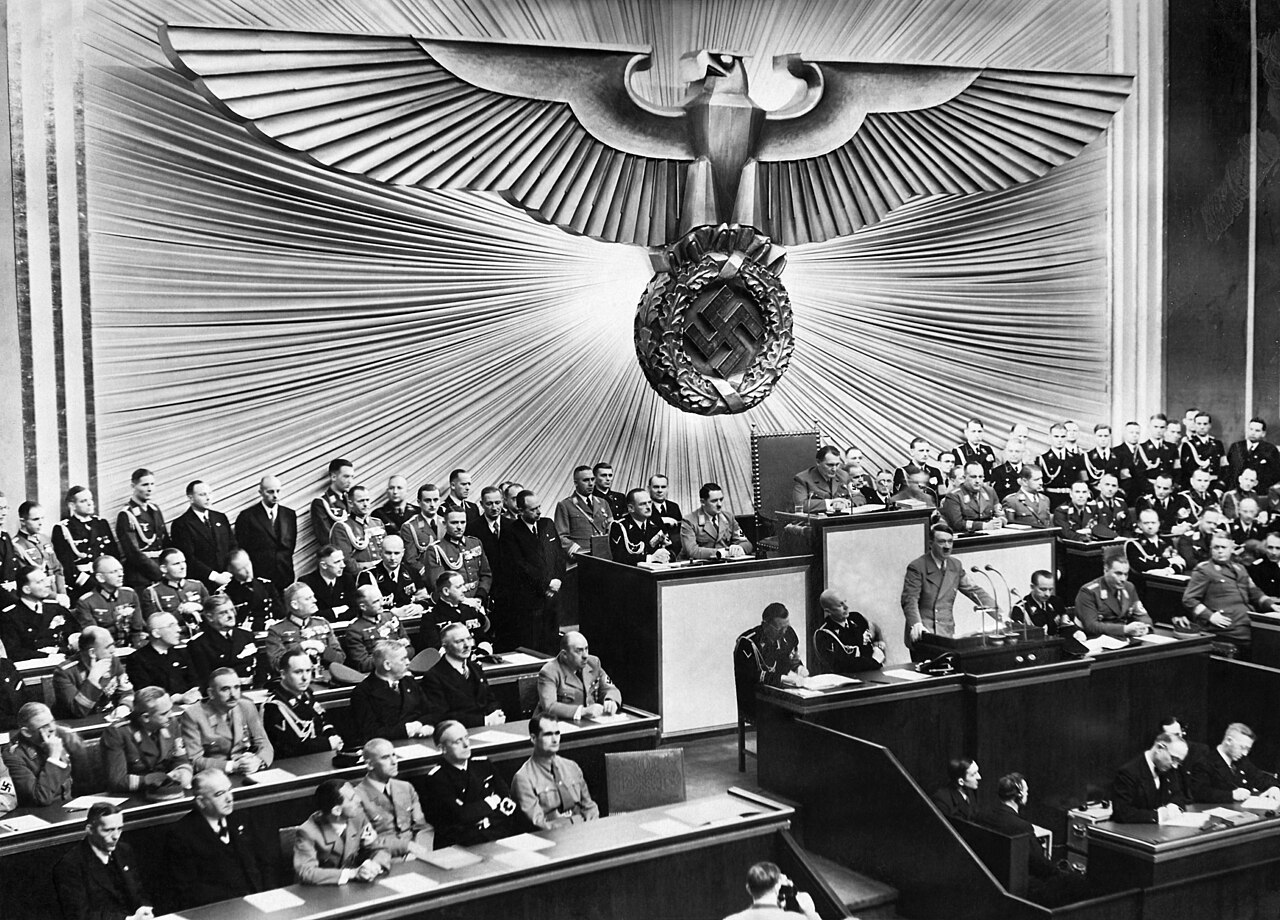
The mechanism of Hitler's rise to power was not a coup or revolution. It was appointment by the very elites who thought they could control him. By November 1932, the Nazi vote had actually fallen to 33.1 percent — evidence that the party's momentum could be stopped through normal democratic processes. But Germany's conservative establishment — wealthy industrialists, Junker landowners, military officers — decided that Hitler was useful: he could suppress the left, restore order, and be managed. On January 30, 1933, President Paul von Hindenburg appointed Hitler Chancellor of Germany.
Within 59 days, Hitler had used the Reichstag Fire (February 27, 1933) as a pretext to suspend civil liberties and arrest Communist deputies, then pushed through the Enabling Act (March 23, 1933) — passed 444 to 94 — which gave the cabinet power to pass laws without parliamentary approval. Democracy was over. The only question was what Hitler would do with the power he now held.
Consolidation was rapid. The Night of the Long Knives (June 30 – July 2, 1934) eliminated the SA leadership — including Ernst Röhm, whom Hitler had known since the early 1920s — to reassure the regular army that the Nazi Party's paramilitary wing would not threaten the Wehrmacht's institutional role. Approximately 85–150 people were murdered in these two days, including former Chancellor Kurt von Schleicher, shot in his own home. When President Hindenburg died on August 2, 1934, Hitler merged the offices of Chancellor and President, becoming Führer und Reichskanzler. The Wehrmacht swore a personal loyalty oath to Hitler by name — an unprecedented constitutional step that would later make it psychologically difficult for officers to justify resistance to his orders.
The persecution of Jewish Germans followed a deliberate escalating pattern. The Nuremberg Laws of September 1935 stripped Jews of German citizenship and prohibited marriage or sexual relations between Jews and non-Jews — a legal infrastructure of discrimination built three years before the mass violence began. By 1938, approximately 300,000 of Germany's 522,000 Jews had emigrated, many losing their assets under confiscatory policies. The 200,000 who remained were trapped.
Kristallnacht (November 9–10, 1938) marked the transition from legal persecution to open violence. The coordinated pogrom — organized by the SS and SA after a Jewish man shot a German diplomat in Paris — destroyed approximately 7,500 Jewish businesses, burned approximately 1,400 synagogues, killed approximately 91–100 Jews directly, and sent 30,000 Jewish men to concentration camps. The name means "Night of Broken Glass," for the shattered shop windows covering German city streets the following morning. Diplomatic protests arrived from Washington and London. Germany ignored them. The lesson was the same as the Rhineland: the democracies would protest and do nothing.
"We have sustained a defeat without a war." — Winston Churchill, speaking in Parliament about the Munich Agreement, October 5, 1938
APPEASEMENT: BUYING TIME OR INVITING DISASTER?
Hitler's rearmament program began within weeks of taking power, in direct violation of Versailles. Germany officially reintroduced conscription in March 1935 and acknowledged the existence of its air force (the Luftwaffe). Britain and France protested through diplomatic channels. They did nothing more.
The pattern was set by the first major test: the remilitarization of the Rhineland.
On March 7, 1936, German troops marched into the Rhineland — the strip of German territory west of the Rhine that Versailles had permanently demilitarized. It was a direct violation of both the Versailles Treaty and the Locarno Treaties (1925), which Germany had signed voluntarily. Hitler later admitted that the 48 hours after the order were "the most nerve-wracking of my life." He had issued secret orders that German troops were to retreat if France mobilized. The German force was small — about 22,000 soldiers — and would have been no match for the French army.
France did not mobilize. Britain urged caution, saying the Germans were "only going into their own back garden." The League of Nations condemned the action; nothing happened. Hitler drew a lesson he would apply again: the Western democracies would not fight. His generals, who had been deeply nervous, learned a different lesson: their Führer's instincts were better than their calculations.
The Anschluss (union of Germany and Austria) came on March 12–13, 1938. Austrian Chancellor Kurt Schuschnigg had called a referendum on Austrian independence; Hitler, fearing the vote might go against him, demanded Schuschnigg's resignation and sent in troops. Austria was incorporated into the Reich. It was a direct violation of the Versailles prohibition on German-Austrian union. Britain and France protested. They did nothing more.
Then came the crisis that most directly shaped the course of events: the Sudetenland.

The Sudetenland was the German-speaking border region of Czechoslovakia, containing approximately 3 million ethnic Germans and, critically, the Czech defensive fortifications that made Czechoslovakia militarily defensible. Hitler began demanding its transfer to Germany in the spring of 1938, orchestrating domestic Nazi agitation among Sudeten Germans to justify intervention.
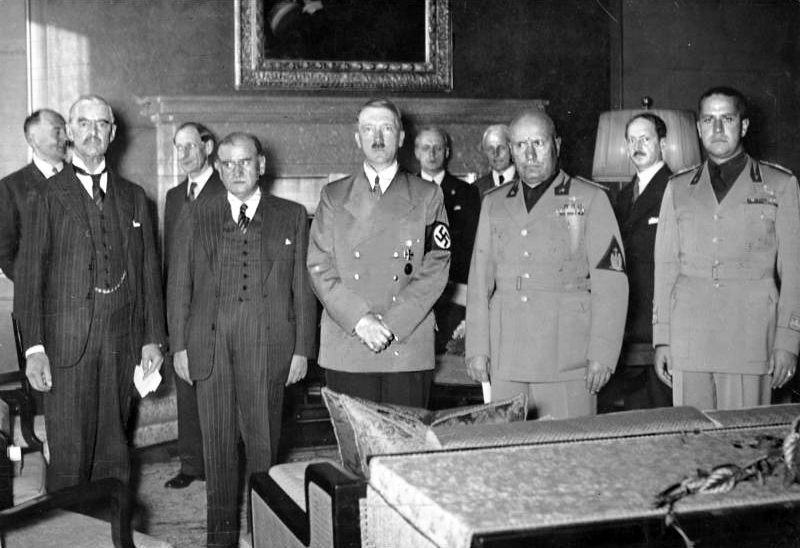
British Prime Minister Neville Chamberlain flew to Germany three times in September 1938 to negotiate with Hitler personally — an extraordinary step for a head of government. The result was the Munich Agreement, signed September 29–30, 1938, by Chamberlain, French PM Édouard Daladier, Hitler, and Mussolini. No Czech representative was present. The Sudetenland was ceded to Germany. Czechoslovakia, stripped of its border fortifications, was now militarily indefensible.
Chamberlain returned to London to a hero's welcome, waving the agreement and declaring "peace for our time." Churchill said in Parliament: "We have sustained a defeat without a war."
Six months later, on March 15, 1939, German forces occupied the remainder of Czechoslovakia. This was not a disputed territory; this was a country with a majority non-German population, seized in clear violation of every principle Hitler had publicly claimed to defend (self-determination of German speakers). The pretense was over. Chamberlain announced a guarantee to defend Poland's independence on March 31 — but his credibility, and Britain's credibility, had been severely damaged by the Munich capitulation.
The appeasement debate remains one of the most contested in modern historical writing. The traditional view, crystallized in the pamphlet "Guilty Men" (1940), condemns Chamberlain as a naive appeaser who enabled Hitler. Revisionist historians, particularly John Charmley, argue that Britain was not militarily ready for war in 1938 — the RAF was still rebuilding, anti-aircraft defenses were thin, and the army was entirely unprepared for a continental campaign — and that Munich bought a year of rearmament time. Most current historians occupy a middle ground: appeasement may have been defensible as emergency triage in 1938, but the failure to build a firm military alliance with the Soviet Union (which had been offering one) and the failure to accelerate rearmament faster in the years 1935–1938 were strategic failures that made Munich necessary.
THE NAZI-SOVIET PACT

The most shocking diplomatic event of the immediate pre-war period was the announcement, on August 23, 1939, that Nazi Germany and the Soviet Union had signed a Non-Aggression Pact — the Molotov-Ribbentrop Pact, named for the two foreign ministers who signed it.
This was ideologically bewildering. Nazi propaganda had spent six years designating Bolshevism as Germany's primary enemy. Soviet propaganda had spent six years warning of fascist aggression. The two regimes had fought by proxy in the Spanish Civil War (1936–1939), supporting opposite sides. And yet here were their foreign ministers in Moscow, posing for photographs.
The public treaty pledged that each country would remain neutral if the other were attacked by a third party. The secret protocols — which the Soviet Union denied existed until 1989 and which were confirmed in Soviet archives only after the USSR's collapse — divided Eastern Europe into spheres of influence. Germany took western Poland and, initially, Lithuania. The Soviet Union took eastern Poland, Finland, Estonia, Latvia, and Bessarabia (a region of Romania).
For Hitler, the pact solved an immediate military problem: it eliminated the risk of a two-front war when he attacked Poland. He could move east without simultaneously having to defend against the Soviets.

For Stalin, the pact was also rational, at least in the short term. Stalin had been attempting to build a collective security arrangement with Britain and France throughout 1938–1939. Britain and France had been slow, suspicious, and condescending in those negotiations — partly because they distrusted Soviet military capability after Stalin's purge of the Red Army officer corps (1937–1938, which removed three of five marshals, 13 of 15 army commanders, and 50 of 57 corps commanders), and partly because Poland flatly refused to allow Soviet troops on its territory even to defend against Germany. When negotiations reached an impasse, Stalin switched sides. He also expected that a German attack on Poland would trigger a long, grinding war between Germany and the Western powers, as in 1914–1918 — giving the Soviet Union time to rebuild its military while the capitalist powers exhausted each other.
What Stalin did not anticipate was that France would collapse in 10 weeks. That miscalculation would be catastrophic for the Soviet Union — and for the 27 million of its people who would die in the war that followed.
On August 25, 1939, Britain signed a mutual assistance treaty with Poland. Hitler briefly considered delaying the attack, then dismissed British resolve as a bluff. On September 1, 1939, at 4:40 AM, German bombs fell on the Polish town of Wielun. World War Two had begun.
THE SPANISH CIVIL WAR: A REHEARSAL
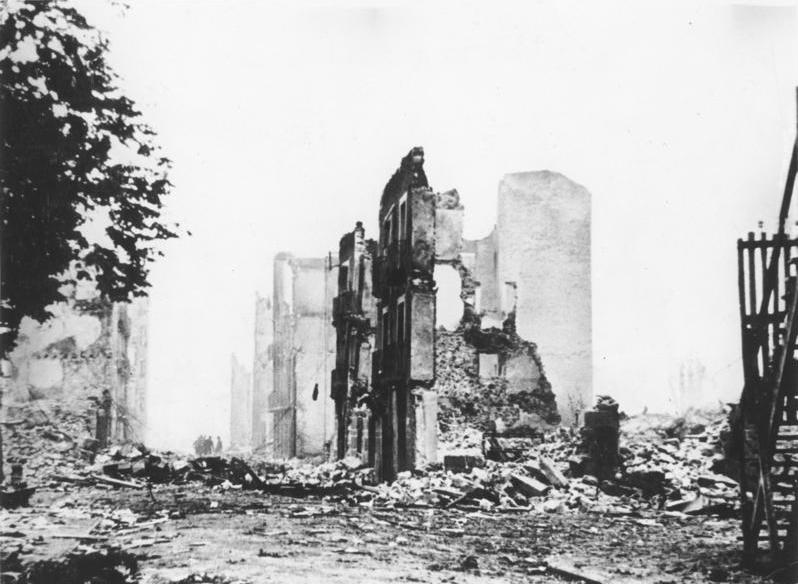
Between the remilitarization of the Rhineland in 1936 and the invasion of Poland in 1939, Germany and the Soviet Union fought a proxy war in Spain that was, for both powers, an operational laboratory.
The Spanish Civil War began July 17–18, 1936, when General Francisco Franco led a nationalist military uprising against the elected Republican government. The conflict quickly internationalized: Germany and Italy intervened on Franco's side; the Soviet Union supplied the Republic; and approximately 35,000–40,000 foreign volunteers from 50 countries (the International Brigades) fought for the Republic. Britain and France declared non-intervention and enforced it against the Republic while largely ignoring German and Italian violations.
Germany's intervention was calibrated: not a full commitment to Franco's victory (which was sometimes delayed by Hitler to prolong the conflict and keep European attention occupied) but a testing program. The Condor Legion — approximately 5,000 to 6,000 German Air Force and Army personnel rotated through Spain — gained operational experience in close air support, the coordination of armor and infantry, and the specific tactic of terror bombing designed to break civilian morale and overwhelm enemy defensive capacity.
The bombing of Guernica on April 26, 1937, was the most notorious single episode. The Basque market town — a civilian target of approximately 10,000 people — was attacked by the Condor Legion for approximately three hours, killing an estimated 150–300 people (the exact figure is disputed; early Republican government claims of 1,600 dead were propaganda exaggerations, but the attack was the most intensive aerial bombardment of a civilian town in European history to that date). The attack was covered by international journalists and became the subject of Pablo Picasso's painting "Guernica" — the most politically charged artwork of the 20th century. German military planners studied the results and adjusted tactics.

What the Spanish Civil War revealed about German armor doctrine was mixed: tanks used in Spanish terrain, against infantry without anti-tank support, performed well. Against prepared anti-tank defenses, they were vulnerable. The lesson German planners drew — that armor must be used in mass, with air support, against undefended flanks rather than prepared fronts — became the conceptual basis of the Blitzkrieg operations of 1939–1941.
For the Soviet military, Spain was also instructive, and the lessons were imperfectly absorbed. Soviet tanks (T-26s and BT-5s) performed adequately against German and Italian equipment. But the organizational and command lessons — the need for radio-equipped tanks, centralized armor doctrine, integrated air support — were not consistently implemented before the Red Army officer corps was gutted in Stalin's purges of 1937–1938. The Soviet Union learned the right lessons in Spain and then shot the men who had learned them.
The Spanish Civil War ended on April 1, 1939 — five months before Germany invaded Poland. Franco's Spain joined the "Anti-Comintern Pact" (previously signed by Germany, Italy, and Japan) but declined to enter World War Two as a belligerent when it came, citing exhaustion and economic devastation. Hitler's attempts to draw Spain into the war at a conference at Hendaye in October 1940 failed; Franco's demands for territory in North Africa were more than Hitler was willing to offer. Spain's neutrality — which frustrated German strategic planners — was one of the more important non-events of the early war period.
Why it matters today
The interwar period offers one of history's clearest demonstrations of how democratic institutions fail. The Weimar Republic was a genuine democracy — it had free elections, a free press, an independent judiciary, and coalition governments. It was destroyed not by a coup but by a combination of economic crisis, elite miscalculation, and a political movement that understood how to exploit democratic rules to end democracy. The pattern — economic stress, political polarization, an authoritarian movement that gains power through legitimate means and then dismantles the institutions that brought it to power — has repeated itself, in different forms, in different countries. Understanding the specific mechanisms of Weimar's failure is not a historical curiosity. It is a practical manual for recognizing the early stages of democratic collapse.
The appeasement debate also remains directly relevant. Every major diplomatic crisis of the 21st century — from the Iraq War to the handling of Russian expansion — has been debated in terms of "Munich analogies." The lesson of Munich is frequently invoked but frequently oversimplified. The real lesson is not "never negotiate with dictators." It is that negotiating from weakness, without military credibility, and while making concessions that destroy your allies' ability to defend themselves, is not diplomacy — it is deferred surrender.
3 key takeaways
- World War Two was not caused by the Treaty of Versailles alone — the war was caused by the failure to enforce the treaty when Germany violated it, starting in 1936. A treaty that isn't enforced is not a treaty; it's a statement of intent.
- The Nazi Party rose to power through democratic elections during an economic crisis. Hitler did not seize power; he was appointed by conservative elites who believed they could control him. They were wrong.
- The Nazi-Soviet Pact was not a betrayal of ideology — it was a rational short-term calculation by both leaders. Stalin expected a long Western war to exhaust Germany; Hitler expected Britain and France to back down again. Both miscalculated, but their errors compounded each other in ways neither had predicted.
KNOWLEDGE CHECK
You finished Day 1 — test yourself
SESSION QUIZ
Check what stuck
1. Versailles left Germany 'humiliated but intact.' Why does Day 1 argue that combination was more dangerous than a Germany that had been either crushed or treated leniently?
2. How did the Wall Street Crash of 1929 translate, within a few years, into 37 percent of the German vote going to the Nazi Party?
3. In March 1936 Hitler sent only about 22,000 lightly armed troops into the demilitarized Rhineland, with secret orders to retreat if France resisted. Why did this small, reversible gamble prove so consequential?
4. A common belief is that Hitler seized power by winning a majority of German votes. What does Day 1 show actually happened?
5. Which statement best captures Day 1's central argument about why the Second World War became possible?