SPAIN - DAY 1 OF 6 · ~32 MIN
Before Spain
Orihuela, April 713. A Visigothic lord sits down to sign a contract with the son of the man who has just taken his kingdom.
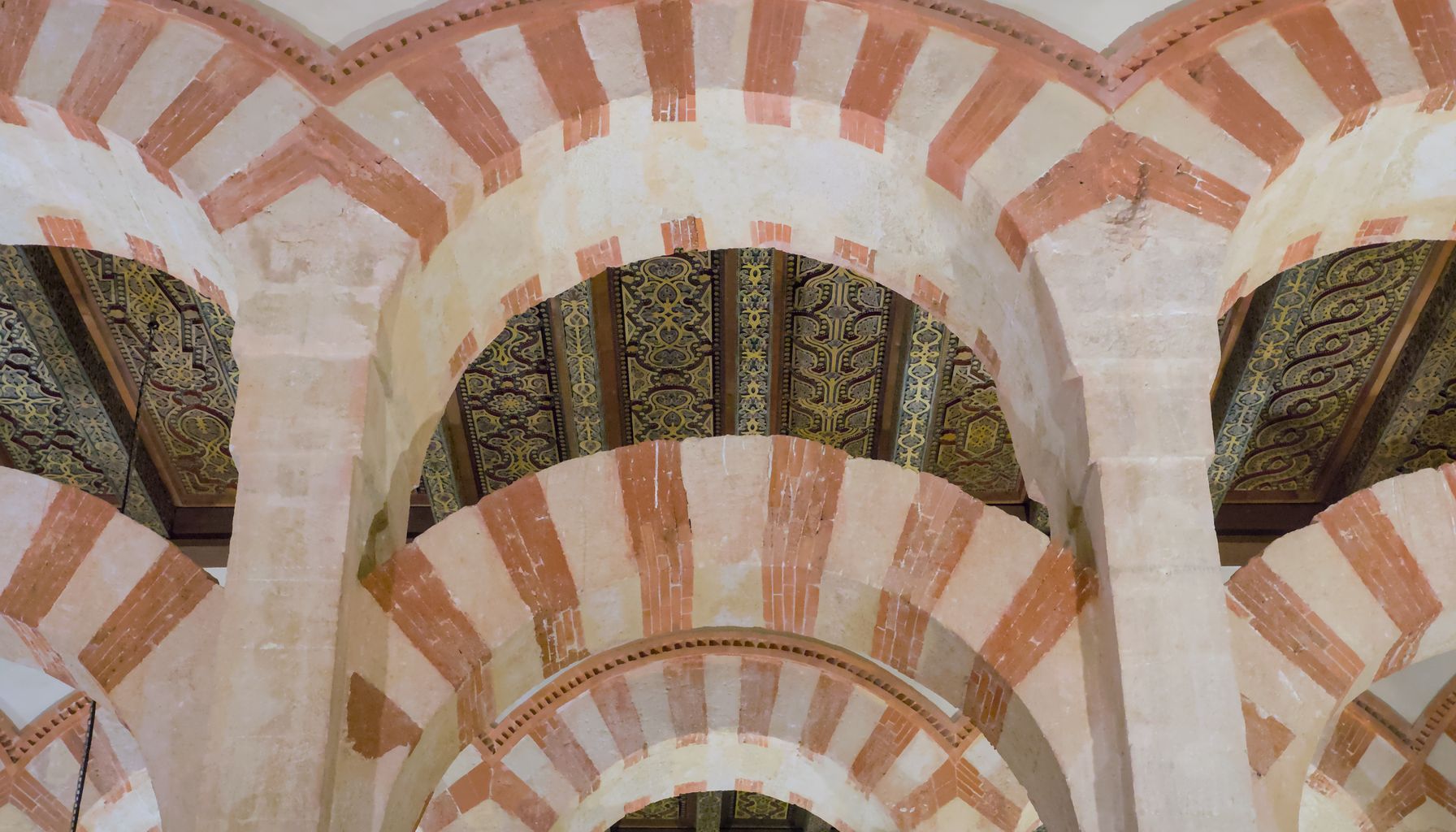
The tiered horseshoe arches of the Mezquita-Catedral of Córdoba, built in alternating brick and stone under a painted timber ceiling. Work on the mosque began in 785, and it was enlarged four times over the next two hundred years. Many of the columns holding those arches up were taken from older Roman and Visigothic buildings, because Córdoba was the fourth capital to stand on that ground. The state that paid for the building was wound up in 1031. The building is still there. Benjamin Smith / Wikimedia Commons / CC BY-SA 4.0
Contents — 10 sections
- OPENING SCENE
- THREE PEOPLES ARRIVE BY SEA, AND ONE KINGDOM MEETS THEM
- ROME COMES FOR CARTHAGE AND STAYS SIX HUNDRED YEARS
- ROMAN GOVERNMENT STOPS
- THE GOTHS BUILD A KINGDOM ON ONE RELIGION
- 711, AND A CONTRACT ABOUT SEVEN TOWNS
- AL-ANDALUS BECOMES A STATE, AND THE NORTH BECOMES SEVERAL
- THE CALIPHATE BREAKS INTO CITY-STATES
- FIVE KINGDOMS DIVIDE THE SOUTH BETWEEN THEM
- PLAGUE, A NEW DYNASTY, AND THE BOARD SET FOR 1469
BEFORE YOU READ
The Caliphate of Córdoba was the strongest state in western Europe around the year 1000, and it was gone by 1031. What destroyed it?
OPENING SCENE

Orihuela, April 713. A Visigothic lord sits down to sign a contract with the son of the man who has just taken his kingdom.
The lord is Theodemir. Arabic writers call him Tudmir. He holds a stretch of the south-east from a handful of walled towns. Two years earlier an army from North Africa crossed the strait and destroyed his king in the field.
The other man is 'Abd al-'Aziz ibn Musa ibn Nusayr. He has come to take the south-east. Instead he writes Theodemir a treaty. Four witnesses put their names to it.
The document is dated in the month of Rajab, in the ninety-fourth year of the Hijra. It opens with the invocation of God, the merciful and the compassionate. That is a calendar and a formula Theodemir does not use.
Then it gets specific. Seven towns are named and Theodemir keeps every one: Orihuela, Valentilla, Alicante, Mula, Bigastro, Ello and Lorca. Five of the seven are on a map of Spain today. Valentilla and Ello have never been securely located.
He keeps his job as well. In Olivia Remie Constable's translation, the conquerors promise that "We ['Abd al-'Aziz] will not set special conditions for him or for any among his men, nor harass him, nor remove him from power. His followers will not be killed or taken prisoner, nor will they be separated from their women and children."
Then comes the clause that does not fit the standard story of 711.
"They will not be coerced in matters of religion, their churches will not be burned, nor will sacred objects be taken from the realm, so long as [he] remains sincere and fulfill[s] the [following] conditions that we have set for him." The square brackets are Constable's, marking words she supplied.
The price is a shopping list. Theodemir must shelter no fugitives and hide no news of enemies. Every free man pays one gold dinar a year. He also pays four measures each of wheat, barley, concentrated fruit juice, vinegar, honey and olive oil. Enslaved men pay half.
The scale is the thing to notice. Nobody signs a document like this about a country. It is signed about seven towns, because seven towns was the size at which this peninsula actually worked.
That was true long before 713 and it stayed true long after. For most of the twenty-two centuries in this day, the land now called Spain was several countries at once. Its rulers fought, taxed, hired and married across the Muslim-Christian line at least as often as along it.
Everything Spain later tried to be is an attempt to settle that. The marriage of 1469, the decrees of 1707, the state built after 1939, the constitution of 1978: each of them arrives after the difference, not before it.
Today's Core Question: If there was no Spain in 711, what exactly was anybody later trying to take back?
DID YOU KNOW?
Two of the seven towns in the treaty that opens this day cannot be found. Orihuela, Alicante, Mula, Lorca and Bigastro are all on a map of Spain today. Valentilla and Ello have never been securely located, so a document from April 713 names two places that nobody has managed to stand in since. King Leovigild is credited with founding two cities, and one of them may not be his. Reccopolis, founded in 578, is securely attested and has been excavated. The second, Victoriacum, is traditionally identified with Vitoria. But twelfth-century sources credit Vitoria's foundation to Sancho VI of Navarre in 1181, six hundred years later, and some scholars place Victoriacum at Iruña-Veleia instead. The bells of Santiago de Compostela made the journey twice. Al-Mansur's army carried them south to Córdoba in 997, where they were hung as lamps in the Great Mosque. When Ferdinand III took Córdoba in 1236 they were carried back north again, after 239 years as light fittings.
THREE PEOPLES ARRIVE BY SEA, AND ONE KINGDOM MEETS THEM

The first people who wrote anything down about this peninsula were visitors. They arrived from three different directions over three centuries, and they all came for the same thing.
It was metal. The south had silver, and the interior had tin, and tin was what turned copper into bronze.
Around 800 BCE traders from Tyre, on the coast of what is now Lebanon, set up a port on an island off the south-west. They called it Gadir, which means something close to a walled enclosure. It is Cádiz.
Their own founding tradition dates the port to 1104 BCE. The archaeology so far reaches only the ninth or eighth century. Either way, Cádiz is the oldest city in western Europe that has been lived in ever since.
The traders came because somebody inland had the metal. Around 750 BCE Greek writers begin describing a rich kingdom on the lower Guadalquivir called Tartessos. Some readers identify it with the Tarshish of the Hebrew Bible. Others do not.
Tartessos faded by about 500 BCE, and nobody has found its capital. What has been found is a single building at Casa del Turuñuelo, near Badajoz, excavated since 2015. In one courtyard lay the remains of more than fifty sacrificed animals, most of them horses.
A horse was the most expensive animal a household could own. Fifty of them in one yard is a great deal of wealth destroyed on purpose. The building was then deliberately buried, which is why any of it survived.
The third arrival was Greek. Around 575 BCE settlers from Phocaea, a city on the coast of modern Turkey, founded a town on what is now the Catalan coast. They called it Emporion, which is simply the Greek word for a trading place. The town's name was its job.
Emporion traded with the Iberian peoples inland for over three centuries. It is Empúries today. A Roman army came ashore there in 218 BCE, which is where the next section begins.

So by 500 BCE the coast held Phoenician ports, a Greek market town and whatever Tartessos was. Behind them, inland, were dozens of separate peoples.
They are usually grouped as Iberians along the east and south and Celtiberians in the interior, but those are labels applied later by outsiders. The Iberians wrote their own language in their own script, adapted from the alphabets the traders brought. It can be sounded out today and still cannot be read, because the language behind it is related to nothing else known.
Then a state arrived that wanted the ground rather than the trade.
Carthage had just lost Sicily to Rome and owed Rome money. In 237 BCE Hamilcar Barca landed at Gadir and began conquering the south. The silver he took out of it paid the debt.
His successor founded a new capital around 227 BCE and called it Carthago Nova, the new Carthage. It is Cartagena. He also agreed with Rome that Carthage would not campaign north of the river Ebro.
Saguntum sat south of that line, on Carthage's side of it. It was also allied to Rome. That is exactly why each side could later say the other had broken the agreement.
In 219 BCE Hannibal besieged Saguntum for eight months and took it. Rome treated that as a breach and declared war. It is the only reason a Roman army ever came to Iberia.
None of this is Spanish history yet, and that is the point of it. Before any outsider arrived to make the peninsula one thing, it was already several things. The first four powers with a stake in it were Phoenician, Tartessian, Greek and Carthaginian, and the war that brought Rome was about none of them.
Traders from Tyre, then Greek settlers from Phocaea, then Carthage under Hamilcar Barca all crossed the sea to this peninsula. What drew every one of them?
ROME COMES FOR CARTHAGE AND STAYS SIX HUNDRED YEARS

A Roman force landed at Empúries in 218 BCE. It landed on the beach of a Greek market town that had been trading there for three hundred years, not on empty ground.
Its orders were to cut Hannibal off from his Iberian base. The war was about Carthage. Rome took Carthago Nova in 209 BCE and finished Carthage in Iberia.
Then it stayed for six hundred years, which needs explaining, because nobody had planned it.
The short answer is that Rome could not leave without leaving the silver. The longer answer is that the peninsula would not stop fighting. Finishing the conquest took about two hundred years, roughly eight generations.
Numantia, in the northern interior, fell in 133 BCE after a siege Rome turned into a set piece. The northern coast held out far longer than that. The Cantabrian Wars ended only around 19 BCE, two centuries after the landing.
Geography explains part of the delay. The Cantabrian range and the Pyrenees are hard country, and the north was the last ground Rome took. The same ground is where a separate state re-forms after 711. That is an observation about terrain and campaigning, not a law of Spanish history.
Once the fighting stopped, Rome built the first framework the whole peninsula shared. Augustus reorganised it into three provinces around 27 BCE. Baetica ran across the south from Corduba, Lusitania across the west from Mérida, and Tarraconensis across the north and east from Tarragona.
Around 73 CE the emperor Vespasian made an offer to every town in Hispania.
Run your town by Roman rules, and the men who hold town office become Roman citizens. So do their families, permanently.

It was citizenship as a reward for cooperation. Within a generation, the local rich were legally Roman.
(One line in one Roman book is our only source for this, so the exact year is argued over. The book is Pliny the Elder's Natural History, and some scholars prefer a slightly earlier year.)
What that looked like on the ground survives in metal. The Lex Irnitana is a set of bronze tablets found near Seville in 1981. It is the fullest surviving Roman municipal charter anywhere: the working constitution of one small town in Baetica, clause by clause.
What the peninsula sent back to Rome was mostly food and metal. Baetican olive oil travelled in thick-walled jars, and Rome smashed the jars once they were empty. The broken pieces built Monte Testaccio, an artificial hill inside the city. It is made almost entirely of Spanish oil jars, in the tens of millions, piled up mainly between about 140 and 250 CE.
At Las Médulas in León, Roman engineers mined gold by demolition. They fed water through galleries drilled into the mountain until the rock collapsed. Pliny, who had administrative sight of the operation, called the technique ruina montium, the wrecking of the mountains.
The traffic ran the other way too. Trajan was born at Italica, outside Seville, and Hadrian's family came from the same town. Two Roman emperors came out of one Andalusian suburb.
The provinces were then cut smaller. Around 293 CE Diocletian divided the peninsula into five, added the Balearic Islands as a sixth, and attached a strip of North Africa across the strait to the same command. Hispania was an administrative unit that did not stop at the water.
What Rome left behind was not a nation. It was roads, a language, a legal habit and a name: Hispania.
Rome governed this peninsula for about six centuries. Measured from the marriage of 1469, Spain has not yet managed six. Every later unifier inherits the Roman idea that the peninsula ought to be one thing. None of them inherits a population that agrees.
Around 73 CE the emperor Vespasian made every town in Hispania the same offer. Why did it turn the local elite Roman inside a single generation?
ROMAN GOVERNMENT STOPS

Roman Spain did not fall in a year. Working out when Roman government actually stopped is harder than it looks, and the answer is that it stopped in different places at different times over about sixty years.
The obvious date is 409. In that year the Suebi, the Vandals and the Alans crossed the Pyrenees. Two years later they divided the Roman provinces among themselves.
They did it by drawing lots. That detail comes from Hydatius, a bishop in Galicia who is the main source for these years and who was a child while they happened.
The practical effect was that the machinery stopped. Taxes were no longer collected, courts no longer sat, and soldiers were no longer paid, across most of the peninsula.
But Rome came back for a while, which is why this is an unravelling rather than a collapse. It hired Gothic troops to fight the newcomers on its behalf. It held the north-east until the 470s, sixty years after the crossing.
The hired troops worked. Gothic forces came south from Gaul under a Roman contract in 416 and fought until 418. The Alans and one group of Vandals were broken as independent powers in those two years, and then the Goths went home again.
The other Vandals left on their own account. They crossed to North Africa in 429 and took Carthage in 439, which supplied Rome with much of its grain. After that the peninsula was no longer the emergency.
Rome played the same card one more time. In 456 Gothic troops came south again on Rome's behalf and destroyed the Suebic king Rechiar near the river Órbigo. Rome was still setting the peninsula's politics, but only by hiring the people who would end up governing it.

It did not remove the Suebi. Their kingdom in the north-west survived the defeat and lasted another 130 years, which is longer than the Roman order it had helped end. The next section is about the king who finally took it.
Hydatius watched all of this from Galicia. In 460 a Suebic raiding party captured him. He was released after three months and went on writing.
He wrote his chronicle as a continuation of an earlier one by Jerome, and he appears to have believed he was recording the end of the world. He was wrong about that. He was right that the government he had been born under was not coming back.
What finally replaced Roman government was a different kind of state. These were kingdoms held together by a war band and a king, not by a tax office.
The Goths ended up as the largest of them almost by accident. In 507 the Franks under Clovis destroyed the Visigothic army at Vouillé and took most of Gaul.
The survivors fell back across the Pyrenees, into a peninsula they had previously governed as a sideline. For a generation the kings held court at Barcelona. From the 550s, under King Athanagild, the seat moved inland to Toledo and stayed there.
So the Goths became an Iberian kingdom because they had lost France. Nobody chose the peninsula. They ran out of anywhere else.
The Suebi, Vandals and Alans crossed the Pyrenees in 409, but Roman government in the peninsula did not simply stop that year. What kept it running?
THE GOTHS BUILD A KINGDOM ON ONE RELIGION

Leovigild ruled from 569 to 586 and did the consolidating. He founded a new city, Reccopolis, in 578, one of very few new cities built anywhere in the post-Roman West. He founded a second called Victoriacum, which may not be Vitoria at all.
In 585 he took the last rival kingdom. The Suebi had held the north-west, meaning Galicia and northern Portugal, for roughly 170 years with their own king. That is about six generations, and for most of the post-Roman period it meant the north-west was a different country.
One king now held almost the whole peninsula. Only a Byzantine strip on the south-east coast held out, and it lasted until 625.
Which raises the question the Goths had to answer. They were a small military elite ruling a large Hispano-Roman majority. Conquest could put one king over both, but it could not make them one people.
Their answer was religion, and it required the ruling class to give up its own.
The Goths were Arian Christians. Arian Christianity held that Christ had been made by God and was therefore lesser than God. The Hispano-Roman majority held that Christ was God, equal and uncreated.
That was not a technicality. It meant two churches, two sets of clergy and two sets of buildings, side by side for a century.
King Reccared, Leovigild's son, ended it by changing sides. The Third Council of Toledo met after three days of prayer and fasting, and on 8 May 589 Reccared renounced Arianism and joined the Catholic Church of the majority. Arian bishops and clergy were transferred into Catholic dioceses. The council was organised by Leander of Seville.
Two religious communities became one. The same councils then began legislating about who stood outside it.

That legislation is documented and dated. King Sisebut issued an edict requiring the baptism of Jews in about 612 or 613. The Fourth Council of Toledo, held in 633, addressed the consequences in its canon 57.
The canon barred forced conversion in future. It also declined to release the people already baptised under compulsion, on the grounds that the sacrament could not be undone. Further legislation followed under King Erwig in 681.
The council of 633 was presided over by Isidore of Seville, Leander's younger brother and the most widely read scholar in the post-Roman West. Around 624, nine years earlier, Isidore had written the first great hymn to this land.
He called it "principum gentiumque mater Spania": Spain, mother of princes and peoples. It was written in Latin, by a bishop, about a Gothic kingdom whose kings had been Catholic for thirty-five years. It has been read ever since as a hymn to a nation.
The kingdom's other instrument was law. Chindaswinth began the work and his son Recceswinth issued the result in 654: the Liber Iudiciorum, a single code running to hundreds of laws.
Its point was that the same law now bound everyone inside the kingdom's borders. Goths and Hispano-Romans stopped being tried under separate legal tracks. (How separate those tracks had ever really been is argued about. Some specialists hold the law was already territorial in practice and that 654 mainly wrote it down.)
The code then outlived the kingdom by six hundred years. Christians living under Muslim rule went on using it after 711. In the thirteenth century it was translated into Castilian as the Fuero Juzgo.
So religion held this kingdom together for about 120 years, and it did so by naming who was outside it. Days 2, 4 and 5 each watch a Spanish government reach for the same instrument.
And the law ran the opposite way to the story most people expect. The peninsula went from one law to many, not from many to one.
Recceswinth issued the Liber Iudiciorum in 654, one body of law binding everyone inside the kingdom's borders. What happened to law in the peninsula after that?
"They will not be coerced in matters of religion, their churches will not be burned…" Treaty of Tudmir, April 713, translated from the Arabic by Olivia Remie Constable
711, AND A CONTRACT ABOUT SEVEN TOWNS

The Gothic kingdom had one flaw it never fixed. The crown was elective, and elections were settled by force more often than by agreement.
King Egica tried to get ahead of the problem in 698 by raising his son Wittiza as co-ruler. It did not work. After Wittiza's death a civil war broke out between his sons and a rival called Roderic, who took Toledo.
The nearest thing to a contemporary account is hostile about how he got there. In Kenneth Wolf's translation, the Chronicle of 754 says Roderic "rebelliously seized the kingdom at the instigation of the senate."
So when Tariq ibn Ziyad crossed from North Africa in 711, under the governor Musa ibn Nusayr, he was not attacking a unified state. He was walking into a succession war that was already running.
Roderic was killed at a place the chronicle calls the Transductine Mountains. The chronicle explains the defeat as a political failure rather than a religious one: "the entire army of the Goths, which had come with him fraudulently and in rivalry out of ambition for the kingship, fled and he was killed."
Within about seven years most of the peninsula was being governed from Córdoba, under the name al-Andalus.
One warning has to sit beside all of that. There is no contemporary account of 711 at all. The Chronicle of 754 is anonymous, written in Latin by a Christian living under Muslim rule roughly forty years after the event, and the Arabic histories are centuries later.
The conquest also consumed the men who ran it. Musa was recalled to Damascus after about fifteen months and paraded through the streets with a rope around his neck.
His son 'Abd al-'Aziz, the man who signed the treaty in the opening scene, married Egilona, King Roderic's widow. He was killed by his own men around 716. The charge that reached the caliph afterwards was that he "tried to throw off the Arab yoke from his neck and retain the conquered kingdom of Iberia for himself." That is how the killing was explained in Damascus, not necessarily why the killers acted.
The treaty of April 713 can now be cashed in, because it is the earliest dated Iberian example of the arrangement that organised the next four centuries.

Christians and Jews kept their religion, their own communal law and their personal safety. In exchange they paid an annual tax and accepted a lower legal rank than Muslims. The Arabic word for people holding that status is dhimmi, meaning protected.
It was not equality and it was not persecution. It was a legal hierarchy with written terms, and the terms were enforceable in both directions. Theodemir went on governing his seven towns for years afterwards.
Constable's own headnote draws the conclusion carefully. The chronicles describe "a quick and violent military victory," she notes, while a document like this one "suggests that the Muslim conquest of the Iberian peninsula may have been a more gradual and piecemeal endeavor," with some cities falling to force and others "won by more peaceful means."
The Chronicle of 754 is also a lesson in how to read a source. It calls the peace Musa imposed around Toledo "an evil and fraudulent peace." Its language about the conquest is bitter throughout, and the bitterness is the chronicler's own.
Yet the same writer treats the Muslim governors as legitimate rulers. He judges each of them by whether he kept order and administered justice. Hostility and acceptance sit in one text, which is roughly what the next three centuries look like on the ground.
The north produced a different kind of document, much later. In 722, by the traditional date, Christian fighters under Pelayo beat a Muslim column in the Asturian mountains at Covadonga.
How large that fight was is genuinely disputed, and the reason is that both accounts of it are arguments rather than reports. The Christian versions were written about 150 years afterwards, in the two texts of the Chronicle of Alfonso III. The Arabic tradition dismisses the survivors as thirty wretches not worth chasing.
Even the year is argued. Claudio Sánchez-Albornoz defended 722; Julia Montenegro and Arcadio del Castillo argue for 718, reasoning from the tenure of the Muslim governor.
What is not disputed is the use later made of it. The Asturian chroniclers claimed that their kings were the rightful heirs of Toledo, and that what had been lost would be restored. That claim is where the whole loss-and-recovery story starts.
Eleven years after the crossing, then, the peninsula had a new ruling power in the south and a founding story in the north. Neither of them was a country.
How close in time to the crossing of 711 is the earliest surviving account of it?
AL-ANDALUS BECOMES A STATE, AND THE NORTH BECOMES SEVERAL

Over the next two centuries the two halves of the peninsula moved in opposite directions. The south went from a province of somewhere else to a state to a rival capital of the Muslim world. The north went from one small kingdom to five separate ones.
The southern change started with a family being destroyed somewhere else. In 750 the Abbasids overthrew the Umayyads in Damascus and killed most of them.
One prince got out. 'Abd al-Rahman crossed North Africa, reached Iberia and took Córdoba in 756. He ruled without reference to the new caliphs in the east, and Córdoba never acknowledged their authority.
That is what 756 means. The peninsula's Muslim territory stopped being a province of anywhere.
What he did not take was the caliphate itself. The title of caliph carried the leadership of the whole Muslim community, and for nearly two centuries his successors left it alone and ruled as emirs, which means princes.
In the north-east, meanwhile, the organising was being done from outside. Frankish troops took Barcelona in 801, and the counties along the eastern Pyrenees became a border zone under Frankish overlordship. Those counties are the ground Catalonia's own law, courts and assemblies later grew from.
Not everyone accepted the arrangement. In 824 Basque leaders and their allies drove a Frankish force out of the western Pyrenees. Pamplona became a kingdom under its own dynasty. It is the kingdom later called Navarre.
By 910 the Christian half of the peninsula was plainly several places. Asturias moved its court south to León and took the city's name. Pamplona was already a kingdom. The Catalan counties were drifting free of the Franks.
That drift is worth watching, because it happened by habit rather than by declaration. Wifred the Hairy died in 897 having passed several counties to his sons, and after that the Frankish kings stopped appointing the counts in practice.
The traditional break comes later, when Count Borrell II stopped renewing his oath after Barcelona was sacked in 985 and no Frankish help arrived. The counts never declared independence. They simply governed without reference to an overlord, while still dating their charters by French regnal years until 1180.
In the south the direction was the reverse. In 929 'Abd al-Rahman III took the title his family had left unclaimed for nearly two centuries and declared himself caliph, from the far western edge of the Muslim world.

He built to match the claim. Madinat al-Zahra, a palace city begun in 936 outside Córdoba, covered about 115 hectares, a little over one square kilometre. It was sacked in 1010, and excavation has been running since 1910 with roughly a tenth of it uncovered.
Two numbers about tenth-century Córdoba circulate everywhere, and both need handling.
The city was never counted. Britannica gives some 100,000 around the year 1000, and specialist estimates run from about 100,000 to several hundred thousand. The much larger figures, including the million that turns up most often, descend from later Arabic writers counting houses, baths and mosques rather than people. What can be said safely is that Córdoba was very probably the largest city in western Europe.
The library of Caliph al-Hakam II is described as holding 400,000 volumes, catalogued in 44 inventories. That figure comes from the medieval writers Ibn Sa'id of Toledo and Ibn Bashkuwal, and some accounts say 600,000. It is a claim by named authors, not a count.
Even read sceptically it dwarfs the comparison. A well-stocked monastic library in Latin Christendom at the same date held a few hundred books.
The people running that state were not all Muslims. Hasdai ibn Shaprut, a Jewish physician at 'Abd al-Rahman III's court, handled Córdoba's correspondence with Byzantium and its dealings with the Christian kingdoms of the north.
Underneath the wealth the population itself was changing. Richard Bulliet estimated that about half of al-Andalus was Muslim by 961 and about 80 percent by 1100. He built that estimate from the dates at which Muslim names start appearing in biographical dictionaries. (The method is contested. Mayte Penelas has argued that it leans on the urban educated elite and uses too few Andalusi cases. It also measures how quickly eventual converts converted, rather than the share of the whole population.)
The caliphate's last strongman was al-Mansur, who held effective power from about 976 to 1002 while the caliph stayed in the palace. The Arabic chronicles record more than fifty campaigns, including the taking of Barcelona on 6 July 985.
In 997 he reached Santiago de Compostela, deeper into Christian territory than any Córdoban force had gone. The cathedral bells were carried back to Córdoba and hung as lamps in the Great Mosque. He died at Medinaceli on 8 August 1002.
So by 1000 there were two systems on this peninsula. One was a single state that had just claimed the leadership of Islam. The other was a set of kingdoms and counties that kept dividing themselves. Neither of them was one country, and within a generation the first would stop being a single state at all.
Between 750 and 1000 the two halves of the peninsula moved in opposite directions. Which way did each of them go?
THE CALIPHATE BREAKS INTO CITY-STATES

The strongest state in western Europe took twenty-two years to destroy itself, and it was destroyed by its own ruling family rather than by any enemy.
Al-Mansur's death opened a rapid succession crisis. His son Abd al-Malik died in 1008 and his second son was murdered in 1009. Between 1008 and 1031 six Umayyads and three rivals held the throne, which is nine rulers in twenty-three years, an average of under three years each.
Madinat al-Zahra was destroyed in the same chaos, seventy-four years after it was begun. In 1031 the last caliph was expelled and the caliphate was abolished outright.
What replaced it was dozens of small states, each built around a single city, each with its own ruler, army and taxes. The Arabic word for them is taifa, meaning a faction or party. Seville, Toledo, Zaragoza, Badajoz, Granada and Valencia were among the largest.
The north was fragmenting at the same time, and by inheritance rather than by war. Sancho III of Pamplona died in 1035 and divided his lands among his sons.
The county of Castile became a kingdom under Ferdinand I in that division, and Aragón became one in the same document. A single inheritance is why Castile and Aragón both turned into kingdoms in the same generation.
The taifas were rich and militarily weak, which produced the defining institution of the century. From about 1045 Ferdinand I turned Zaragoza, Seville, Badajoz and Toledo into tributaries. They paid annual sums in gold and silver in exchange for protection and non-aggression. The payments were called parias.
Alfonso VI extended the system and treated the income like any other royal asset. Tribute rights were split between heirs in wills, one son inheriting the payments from Zaragoza and another those from Toledo.
In 1074 Alfonso raided Granada until it began paying too. He did it using troops supplied by Toledo, one of his existing tributaries. For most of the eleventh century, Christian expansion was financed by Muslim taxes.
That is the context for 25 May 1085, when Alfonso VI took Toledo. He took the old Gothic capital, and he took a city his family had been living off for a generation.

The response came from outside the peninsula altogether. On 23 October 1086 the Almoravids, a North African empire, beat Alfonso VI at Sagrajas. They then absorbed the taifas they had crossed over to rescue. Al-Andalus was reunified by force from abroad, and the tribute stopped.
One career shows what the fighting actually looked like. Rodrigo Díaz de Vivar was exiled by Alfonso VI in early 1081, went looking for work and found it in Zaragoza, in the service of its Muslim ruler al-Mu'tamin.
Fighting for Zaragoza, he defeated the Count of Barcelona at Almenar in 1082 and an Aragonese army at Morella in 1084. He was exiled a second time in 1088, with his property confiscated, a penalty normally kept for treason. He took Valencia on 15 June 1094 and ruled it until his death in 1099.
The title he is remembered by is Arabic. Sidi means my lord, and it is what his Valencian subjects called him. His own signature survives on a Valencia cathedral dedication of 1098: Ego Ruderico.
Muslim rulers used Christians and Jews in the same way. Samuel ha-Nagid was vizier of the taifa of Granada, commanded its armies in the field and wrote Hebrew poetry that is still read. His son Joseph inherited the office.
In 1066 a crowd stormed the palace in Granada, killed Joseph and killed many of the city's Jews. Later Arabic sources give death tolls that cannot be checked. What is documented is what the quarrel ran on: taxation, patronage and the position of a non-Muslim vizier.
Both of those things are the same society, which is why al-Andalus is one of the most argued-over subjects in Spanish history. Américo Castro coined the term convivencia, living together, in 1948. Claudio Sánchez-Albornoz attacked it as reading modern liberal values back into a society built on other premises.
The argument is still live. Darío Fernández-Morera and Serafín Fanjul hold that the coexistence story has no adequate foundation in the record. Thomas Glick, María Rosa Menocal, Kenneth Baxter Wolf and Brian Catlos treat coexistence as real but unequal and constantly shifting, and Catlos prefers the word conveniencia, coexistence as convenience. David Nirenberg has argued that periodic violence was part of how the arrangement worked rather than a breakdown of it.
The evidence does not settle it. What it carries is narrower: Al-Andalus had a legal hierarchy, with Muslims first and protected Christians and Jews taxed and restricted under it. Alongside that ran genuine cultural exchange, and periods of both tolerance and violent persecution.
Neither side was a side, and neither "paradise" nor "myth" survives contact with the record.
The Caliphate of Córdoba was the strongest state in western Europe around the year 1000, and it was gone by 1031. What destroyed it?
FIVE KINGDOMS DIVIDE THE SOUTH BETWEEN THEM

In 1137 the Count of Barcelona was betrothed to Petronila, the heiress of Aragón. A kingdom and a group of counties came under one ruling family.
Nothing else merged. Each side kept its own law, its own courts and its own assemblies, and each went on being governed as itself. That is the Crown of Aragón, and the formula is the one used again in 1469.
Meanwhile the pattern in the south repeated twice more. Two North African empires crossed the strait and reunified most of al-Andalus by force: the Almoravids from the 1080s, then the Almohads from the 1140s. Each held it for decades, and each broke apart in turn.
The second collapse was sudden and datable. On 16 July 1212 Castilian, Aragonese and Navarrese armies fought together against the Almohads at Las Navas de Tolosa. Three kings rode in it: Alfonso VIII of Castile, Peter II of Aragón and Sancho VII of Navarre.
Getting three of them into one field took a papal crusade bull and a truce between them. It did not last, and they were fighting each other again within a few years. But Almohad power in the peninsula never recovered, and the Guadalquivir valley lay open.
The chains on Navarre's coat of arms are traditionally said to come from that battle. It is a tradition rather than a documented fact.
Eighteen years later the largest Christian state settled its own shape. Ferdinand III inherited both Castile and León in 1230 and the two were never separated again. That single kingdom became the biggest state in the peninsula, and it is the one that later owned the Americas in law.
Then the conquests came fast, and the striking thing is how deliberately they were divided up in advance.
Córdoba fell on 29 June 1236. Ferdinand III took the old caliphal capital, and its great mosque became a cathedral. The bells taken from Santiago de Compostela in 997 were carried back north, 239 years after they went south.
On 9 October 1238 James I of Aragón took Valencia. He did not attach it to Aragón or to Catalonia. He set it up as a separate kingdom with its own law and its own parliament, making three distinct territories inside one crown.

Much of the Muslim farming population stayed on the land under new landlords. That single decision is why Valencia still had a very large population of Muslim descent in 1609, which is Day 3's problem.
James I also wrote his own memoir, the Llibre dels fets, in the first person. Very few medieval kings did anything of the kind.
The reason a line was needed at all is that both crowns were now moving on the same ground. Murcia had submitted to Castile in 1243, which put Castilian authority directly south of Aragón's new kingdom of Valencia.
On 26 March 1244, at Almizra, Castile and Aragón drew a line south of Valencia and split the future between them. It was an agreement in advance about who was allowed to conquer what.
The line ran between Biar and Busot. Aragón's expansion inside the peninsula stopped there, and it turned to Sicily, Sardinia and the Mediterranean instead. The line was redrawn sixty years later, which is why Alicante ended up inside Valencia and Murcia did not.
Seville fell on 23 November 1248 after a siege of sixteen months, and settlers were brought down from the north to hold it. Only Granada survived as a Muslim power of any size, and it survived by paying tribute to Castile. The small taifa of Niebla held out until 1262.
How the captured land was handed out mattered for centuries. Castile divided it by written register, in blocks, among settlers, nobles and the military orders of Santiago, Calatrava and Alcántara.
The orders were fighting brotherhoods with their own rules and their own masters, and they had done much of the campaigning. They were paid in ground. That is why the south of Spain ended up in a small number of very large estates, which is an argument Days 4 and 5 are still having.
So in the thirty-six years between Las Navas and Seville the political map went from many pieces to five. Castile-León, the Crown of Aragón, Portugal, Navarre and Granada.
Five is not one. And the clearest evidence that nobody involved thought this was one country is Almizra itself. Two of those five sat down and signed a treaty about which of them owned the future.
On 26 March 1244 Castile and Aragón met at Almizra and drew a line between Biar and Busot. What were the two of them agreeing?
PLAGUE, A NEW DYNASTY, AND THE BOARD SET FOR 1469

Two things arrived in the fourteenth century that no king had planned for. One was a disease. The other was a disputed succession. Between them they set the board that 1469 was played on.
The plague came first, through the ports, in 1348. It killed a large share of the population everywhere, and it hit Catalonia and Aragón hardest of all.
Catalonia counted households for tax, which is why the damage can be measured. The hearth counts fall from roughly 90,000 in 1378 to under 60,000 by 1497. A third of Catalonia's households were gone, and they were still gone a century later.
That is why Catalonia's weight inside its own crown fell for a hundred years, and it is the beginning of Castile becoming the senior partner in everything that follows.
Catalonia's answer to a shrinking tax base turned into something nobody designed. In 1359 its parliament, the Corts, appointed a standing committee to collect the taxes it had just voted.
The committee's second job was to watch that the king kept the law. It then stayed in being between sessions of parliament, because there was always more tax to collect. That is how a tax office became a government.
The body was later called the Generalitat. It has been abolished twice and restored twice since, and it still runs Catalonia under that name today.
The disputed succession was in Castile, and it was settled with a knife. On 23 March 1369 Henry of Trastámara killed his half-brother Peter I in a tent at Montiel and took the crown.
The war behind that killing was not only Castilian. English and French troops fought on opposite sides of it, which means the Hundred Years War was fought inside Castile too.
Henry owed his throne to the nobles, towns and foreign soldiers who had backed him, and he paid them in land and privileges. This is the family that later supplies both Isabella and Ferdinand.
Twenty-two years later came the event that changed who lived in Spain. Attacks on Jewish quarters began in Seville on 6 June 1391 and spread to more than seventy towns within four months, across Castile and the Crown of Aragón.

Many thousands of people accepted baptism to survive. That created a group that had not existed before: baptised Christians of Jewish descent, called conversos.
The legal position is the part that matters later. A converso was a Christian in law. That put them inside the authority of the Church and outside the protections that applied to Jews, and everything the Inquisition later did depended on their existing.
The last piece of the board was set by committee. Aragón's royal line died out, so in 1412 nine appointed delegates met at Caspe to choose the next king, three from Aragón, three from Valencia and three from Catalonia.
On 28 June 1412 they chose Ferdinand of Antequera, a Castilian prince of the Trastámara house. Aragón and Castile now had branches of the same family on their thrones. That is the only reason a marriage between them was possible at all.
One more voice belongs here, from 1456. Alonso de Cartagena, Bishop of Burgos, finished a genealogy of the kings of Spain that year and left instructions for the man illuminating it.
He told the illuminator to show the past as a recovery rather than a conquest: when "we drive this rabble out of our territory, we do not win new enterprises but recover the ones we lost." The word rabble is his. That is a bishop, seven hundred years after 711, telling a painter how to make history look like a loss being repaired.
The idea of recovery is genuinely medieval, and that sentence is the proof of it. The label now stamped on the whole period is not medieval at all, and Day 4 deals with where that word came from and when.
So here is the board as it stood in 1468. Five states shared the peninsula: Castile-León, the Crown of Aragón, Portugal, Navarre and Granada. The Crown of Aragón alone contained three parliaments and three bodies of law.
There were separate currencies, separate customs frontiers and separate courts. There was a large converso population that nobody had decided what to do with. And there was a Castilian family sitting on two of the five thrones.
Twenty-two centuries had produced no Spain. What they had produced was a set of pieces close enough together that somebody could try to join them.
Why it matters today
Spain still does not have one civil law. Article 149.1.8 of the 1978 constitution reserves civil legislation to the state. It then preserves the separate civil-law systems of the territories that already had one. In practice that means Catalonia, Aragón, Navarre, the Basque Country, Galicia and the Balearic Islands. Inheritance, marital property and family arrangements can work differently depending on which of them a Spanish citizen lives in.
That is a direct inheritance from this day. One territorial code was written in 654. It broke into local law across the medieval kingdoms, and the modern state has never fully reassembled it, because reassembling it has always meant taking something away from somewhere.
Some of the institutions in this day are still operating under their original names. The Generalitat set up in 1359 to collect Catalan taxes is the government of Catalonia today. Cádiz, founded as a Phoenician trading post, has been continuously inhabited ever since.
The physical evidence is also still coming out of the ground. Madinat al-Zahra, sacked in 1010, has been under excavation since 1910 with about a tenth of it exposed, and it was added to the UNESCO World Heritage List in 2018. Casa del Turuñuelo has been producing new evidence about Tartessos since 2015.
And the deepest inheritance is the one the next five days are about. Catalonia, the Basque Country and Galicia all reach back past 1469, past any Spain at all, for their claim to be nations within Spain. Whether that history supports the claim is precisely what Spanish politics has been arguing about ever since.
3 key takeaways
- For the twenty-two centuries before any Spanish state existed, the peninsula's normal condition was several separate states at once, whose rulers crossed the Muslim-Christian line for money, troops and thrones.
- The Visigothic kingdom shows the instrument Spain kept reaching for. Religion held it together for about 120 years, and it did so by naming who stood outside it.
- Law ran the opposite way to the story most people expect: one territorial code for everyone in 654, then separate local law in every kingdom by 1468.
KNOWLEDGE CHECK
You finished Day 1 — test yourself
SESSION QUIZ
Check what stuck
1. The treaty signed at Orihuela in April 713 names seven towns, one gold dinar a year from every free man, and four measures each of wheat, barley, vinegar, honey and oil. What does that level of detail tell you?
2. Reccared renounced Arianism at the Third Council of Toledo on 8 May 589, and the kingdom's two religious communities became one. What did the same conciliar machinery then start doing?
3. Rodrigo Díaz de Vivar was exiled by Alfonso VI in 1081, went looking for work, and found it with al-Mu'tamin, the Muslim ruler of Zaragoza. Whom did he beat for that employer?
4. Aragón's royal line died out, and on 28 June 1412 nine appointed delegates meeting at Caspe chose Ferdinand of Antequera as king. Why does that choice matter to everything after it?
5. Tenth-century Córdoba is usually described with two numbers: a population approaching a million, and a caliphal library of 400,000 volumes. How should those figures be handled?